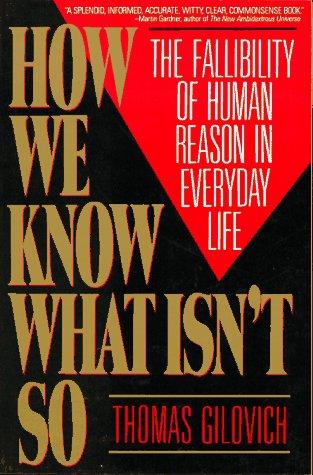
How We Know What Isn’t So
by Thomas Gilovich
Buy on AmazonDiscusses the processes through which we become convinced of the validity of questionable or false beliefs such as special psychological powers and New Age health practices.
Recommended by
"My undergraduate thesis advisor, who knew I was interested in going to grad school, handed me this book. After reading it, I knew this was exactly the kind of work that I wanted to do. I applied to work with Tom. He became my PhD advisor. “Acts of commission, things that people do, come to mind more readily than acts of omission, things that people don’t do.” This is a book about intuitive human judgment and how the way we think about the world can be distorted and misdirected—by forces within our own mind, like our tendency to think well of ourselves; by cognitive forces, such as the ease with which information comes to mind; and by environmental forces, like asymmetries in feedback. So, for instance, acts of commission, things that people do, come to mind more readily than acts of omission, things that people don’t do. So our judgments can be distorted by the presence of information, as opposed to its absence. And that can lead to systematic mistakes. How We Know What Isn’t So remains the best book in the field at describing the basic psychological mechanisms that can lead even super smart people to make mistakes. Heuristics are just a shortcut or a rule of thumb, often contrasted with more analytical or algorithmic reasoning. An example of heuristics is that we judge the likelihood of an event by the ease with which it comes to mind. So if something is easy to imagine—for instance, somebody come to your house and shooting you with a gun—we might overestimate the likelihood of that happening in the world. So heuristics are simply intuitive mechanisms for human judgment."
Behavioral Science · fivebooks.com
"This is a really smart book and the reason I put it on there is that it really invented the genre of science non-fiction. Gilovich did some very interesting work (actually with Tversky when he was still at Cornell) including on the ‘hot hand’ effect. This refers to basketball when players think they have a ‘hot hand’. They make three shots in a row: fans think they’re in the zone. But actually the hot hand is a cognitive illusion. After making a couple of shots in a row, players actually get over-confident and become less likely to make their next shot. So the book is filled with case studies like that, clever demonstrations that so much of what we perceive in the world, and then use to act on, is actually based on cognitive illusions. So this book is very accessible. It was very popular and demonstrated for the first time that people love to learn about their biases. There’s really something fascinating about reading your own user manual and going, ‘Oh that’s what made me do that stupid thing all the time!’ If you want to summarise it, a large part of the book is about positive information bias – the fact that we like to believe that we’re right and so we ignore all sorts of evidence that suggests we might be wrong. That’s why conservatives watch Fox and liberals watch MSNBC. Which isn’t the biggest revelation in the world – but there’s all sorts of clever studies that demonstrate this again and again, that show just how blinded and blinkered we are. We think we’re so objective, but there’s actually nothing objective about the human mind. We have these working beliefs and we seek evidence to confirm beliefs: that, unfortunately, is the best summary of how we seek out evidence."
Decision-Making · fivebooks.com