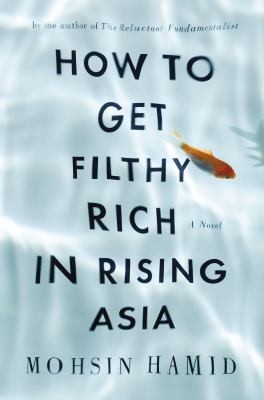
How to Get Filthy Rich in Rising Asia
by Mohsin Hamid
Buy on AmazonDans un pays imaginaire du continent indien, un jeune homme, issu d'un milieu modeste d'agriculteurs, se rend à la ville. Il poursuit des études, trouve l'amour, s'intéresse à la politique, fait fortune dans le conditionnement de bouteilles d'eau avant que la chance ne tourne pour lui.
Recommended by
"This novel, by Mohsin Hamid, employs the conceit of a how-to book for South Asians. Its exemplar is a country boy on the make, a serious character whose essence remains his own yet who stands as a figure representative of his time and place. Each of the chapter titles offers a sometimes straightforward, sometimes ironic imperative. “Move to the City.” “Get an Education.” “Don’t Fall in Love.” “Learn from a Master,” and so forth. Given the unabashed gimmickry of Hamid’s how-to design, it’s a wonderful surprise to find his book so engaging."
NPR Books We Love — 2013 · apps.npr.org
Publishers Weekly's Best Books — 2013 · publishersweekly.com
"It is a bold thing to say, but on the other hand, it’s something that quite a few contemporary authors are saying. Not just Hamid, but Sheila Heti, Brenda Lozano, and others have made similar observations. Hamid’s book was really generative for me because each section is titled after a different self-help imperative: ‘move to the city’, ‘get an education’—things that you would find in a self-help manual. Well, that’s what’s interesting about the text; it’s using the second-person voice. So it’s at once describing things that everyone should do from that commanding, imperative voice of the self-help manual: move to the city if you want to be successful, don’t fall in love, things like that. But at the same time, it’s also describing the particular narrative of this one character, and it’s oddly collapsed in this figure of “you,” who is both the protagonist and the author, but also the reader, who identifies with the protagonist through the second-person voice. Each chapter is titled according to this self-help rule and then often begins with a kind of deconstruction or theorization of the self-help genre, or one aspect of it, in a way that I actually found really intriguing as someone writing a book about literature and self-help. “He began by thinking that self-help was funny and a little bit silly” You can read in interviews with Hamid this story of how, like many of the authors on the list, he began by thinking that self-help was funny and a little bit silly, but really that his relation to the genre evolved the more he thought about it and took it seriously and thought about what it has in common with other wisdom traditions, like the tradition of Sufi love poetry also invoked in the novel. The more he thought through the genre, the less easily he could dismiss it as something trivial. He’s particularly interested in the global status of self-help is something that’s as popular in Asia as it is in the United States now, and as something that’s come to take the place of more politicized or fraught sources of advice or authorities on how to live in these places—like religion, for instance. He’s interested in the way that self-help is taking up that space and offering a venue for thinking through problems of how to live. In a way, the story ends up a counter-example to the advice given by the self-help manual voice. So the self-help manual voice will say ‘don’t fall in love’, but the actual narrative is showing how, actually, the process of falling in love and family and all the things that are left out of this self-help manual actually become the most important and the most meaningful to the character’s life. It’s that ‘life is what happens while you’re busy making other plans’ kind of idea. But also I think that the self-help becomes a foil for these texts’ own kind of life philosophy or literary ethics that ends up emerging in contrast to the rules the self-help manual is laying out."
The Best Self-Help Novels · fivebooks.com