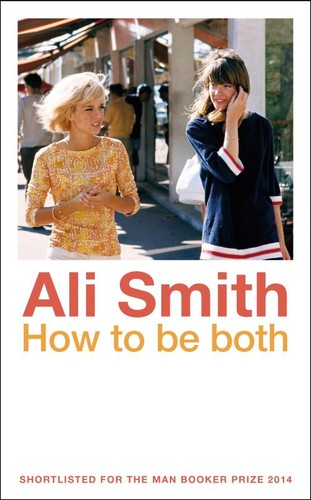
How to Be Both
by Ali Smith · 2014
Buy on AmazonThis is a novel all about art's versatility. Borrowing from painting's fresco technique to make an original literary double-take, it's a fast-moving genre-bending conversation between forms, times, truths, and fictions. There's a renaissance artist of the 1460s. There's the child of a child of the 1960s. Two tales of love and injustice twist into a singular yarn where time gets timeless, structural gets playful, knowing gets mysterious, fictional gets real - and all life's givens get given a second chance.
Recommended by
"This is the novel that is least explicitly interested in the contemporary self-help genre, even though it is using this how-to title; it doesn’t actually make any explicit reference to a contemporary self-help manual. But it does reference this more ancient practice, this Renaissance tradition of textual advice, particularly in the form of painting manuals that the character Francesca reads in order to find advice not only about how to paint, but also about how to live. That was really interesting to me because it involves this whole tradition of people using self-help as a tool of self-teaching or auto-didacticism, who have been excluded from more official or traditional apprenticeship or educational possibilities. Francesca reads these painting manuals to learn how to be a painter, even though women were not considered legitimate apprentices for these artistic positions. How To Be Both is showing how a person can use self-help reading subversively for their own purposes, and that self-help’s influence is not always as authoritarian as one might think, but that actually there’s a lot of potential there for flexibility in terms of what readers take selectively from self-help. For example, well the book references two manuals, one is by renaissance humanist Alberti and the other is by the Italian renaissance painter Cennini. I think it’s the Cennini passage where Smith references: The great Cennini, though, in his handbook on colours and picturemaking, finds no worth and no beauty of proportion in girls, or in women of any age – except in the matter of hands in themselves, since the delicate hands of girls and women, providing they’re young enough, are more patient, he says, than those of a man, from spending so much more time indoors which makes them more suited to making the best blue. Myself I went out of my way, then, to be expert at the painting of hands and be good at the grinding of blue and the using of blue, both So that’s an example of somebody selectively adapting this advice that is really excluding their own group or identity from its purview and using it in strategic ways. In Smith’s work in general, although she’s not directly addressing self-help, she’s very much critiquing a lot of the intellectual or cognitive impulses that underlie the desire and demand for self-help. The idea of ‘how to be both’, the critique of dualistic thinking, polarizing thought and reductive solutions and facile answers—all of that is something that’s being challenged by the experience of reading her narrative, in interesting ways. How To Be Both becomes a kind of riddle as you’re reading it; you’re trying to figure out how the novel is going to answer that question. There’s so many different possibilities that come up when you read it. Is it how to be both genders? How to be in both times? Back to that theme of time travel we see with Yu’s book. It invites a more flexible and nuanced way of thinking that I think is offering a useful antidote to some of the tendencies that are encouraged by self-help literature, particularly the impulse towards reductive and overly schematic thinking. She doesn’t adopt the pretense of expertise upon which so much self-help relies. Another thing that really fascinates me about her is that she wrote her dissertation on modernist literature. Apparently it had something to do with modernism and ordinary life, or something like that—I would just love to get my hands on it and read that dissertation. No, I really think that anything that disseminates literature and gets people interested in literature and introduces people to literature is a good thing. And if it’s going to decontextualize literature, I don’t really mind that. For example, a lot of people first encountered the philosopher William James through Dale Carnegie’s handbook How To Win Friends and Influence People , because Carnegie quotes William James in that book. So their initial counter with James in Carnegie will be decontextualized, but then they’ll go and read more James and learn more about him and his context. It’s not the end of the story—it’s really just a gateway into further study. So I tend to have a less critical view of that particular work that self-help is doing. What I find really interesting about these literary engagements with self-help is their willingness to think about what self-help can teach us about reading and about literature, and about why people are interested in literature and what brings them to books. It doesn’t mean that they all end up supporting the way that self-help relates to readers, or the way that it supplies readers desires for flattery, consolation, or self-affirmation. Quite to the contrary, many of these novels end up subverting and complicating those desires and expectations. The conclusion is often that the individual’s desires are just not the center of the universe. Thank you. So there’s a real agency on the part of the reader that becomes possible through that. It’s not really the very hierarchical relationship that many people associate with self-help. Actually, the self-help reader I think has a lot more agency than has previously been recognized by a lot of intellectual work on the topic. Contemporary novels are beginning to see that there’s a lot to be learned and thought through by studying why people read self-help, and what self-help has in common with literature—even if they don’t agree with the kind of methods and aims of the traditional self-help book. To me, that’s the most exciting aspect of that relationship."
The Best Self-Help Novels · fivebooks.com