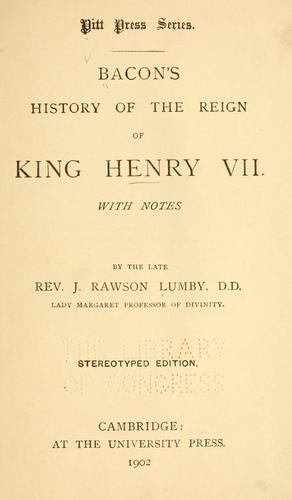
The History of the Reign of Henry VII
by Francis Bacon
Buy on AmazonBacon’s book is a terrific psychological portrait of Henry VII. As well as a philosopher and pioneering scientist, Bacon was an influential politician: Lord Chancellor during the reign of James I, who came to the throne in 1603 after the death of Elizabeth I. In 1621, Bacon’s career ended in disgrace – he was convicted of corruption and sacked. He went away to his large house in the country and wrote the history of Henry VII, who was James I’s great-great-grandfather. What is interesting about this book for me is that it’s a book written by someone who was himself a practising politician. Bacon is the first writer to get into Henry VII’s mind and under his skin. What I love about what Bacon does is that he intends the book to be true to life – it’s not a hagiography. Bacon said that if Henry were alive again, he hoped that the king would not be angry with the portrait that Bacon had painted but would rather be pleased, “in seeing himself so truly in colours that will last and be believed”. Support Five Books Five Books interviews are expensive to produce. If you're enjoying this interview, please support us by donating a small amount . Although I think he is wrong in some of his interpretations – for example, I argue in my book that Henry and his wife were close, rather than distant, as Bacon says, and I also think that Bacon to an extent misunderstands Henry’s avarice and the way it functions – it remains an exceptional study of power. I think partly it is because Henry doesn’t lend himself to caricatures in the way that Henry VIII – the fat monarch with lots of wives – does. What is intriguing about Henry VII is his ability, despite having no claim to the throne, to gain power and hold on to it. And the oppressive control that he exercises over government, particularly in the last years of the reign, which are years of secrecy, intrigue and terror. Henry VII is unable to make his subjects love him – so he makes them fear him instead. Exactly so, and when the 17-year-old Henry VIII ascends the throne in 1509 he has to go through this extraordinary contortion of presenting himself both as heir to his father, and – because his father’s reign became so oppressive – as something fundamentally different from him at the same time. Henry VIII had to portray himself as the antithesis of his wintry, avaricious father – as this young prince who would usher England into a glorious new age. He was indeed, and this is accentuated in the way he defined himself against his father. In fact, the reaction to Henry VII’s reign in 1509 sets the tone for how we continue to see the first Tudor king today.