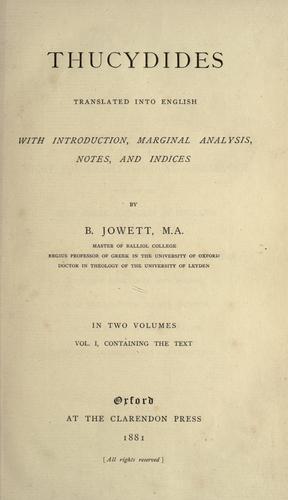
History of the Peloponnesian War
by Thucydides
Buy on AmazonWritten four hundred years before the birth of Christ, this detailed contemporary account of the long life-and-death struggle between Athens and Sparta stands an excellent chance of fulfilling its author's ambitious claim. Thucydides himself (c.460-400 BC) was an Athenian and achieved the rank of general in the earlier stages of the war. He applied thereafter a passion for accuracy and a contempt for myth and romance in compiling this factual record of a disastrous conflict.
Recommended by
"To understand American foreign policy you have to understand what foreign policy and international relations more generally are. Thucydides is the single best treatment of international relations, foreign policy and military affairs that exists. It is the best description of what life in a multipolar world is like, what politics and war are like for the units involved, of the basic realities of international relations. It has no single line. Thucydides is often considered the father of the “realist” tradition in international relations, because he argued that the root cause of the Peloponnesian War was Athens’s growing power and the fear this caused in Sparta. But there is everything and its opposite in Thucydides. It’s a brilliant, kaleidoscopic, panoramic view of states in action in the international sphere. You see what war does to domestic politics; you see what domestic politics does to war. You see what morality in wartime is like and what the consequences are. You see what alliance behaviour is like, and what the pressures of the system do to various different players inside. What he is describing is the world of a state system – in this case Ancient Greek city-states – but the same dynamic that prevailed then is the world we see today in many, many respects. And nobody has captured the essence of that world better than Thucydides. So the reason Thucydides is on my list is to teach people what the world of international relations and foreign policy and war is all about. Only then, once you know that, can you turn to America and understand what the United States is doing, as one particular actor operating in that world. One of the great things about Thucydides is that every age that reads it finds great insight into their own era. It’s like reading Shakespeare or any true classic. It’s describing human nature and human relations in some particular concrete setting, but it gets at the essence, at the heart of that. So during the Victorian era, the British saw themselves as Athens; during the Cold War, the United States saw itself as Athens. If you want to understand alliance dynamics, you look at [the Athenian alliance] the Delian League. Every time there is a mistaken expedition to a godforsaken place which should never have been undertaken in the first place, people bring up the Sicilian expedition. Every time alliance partners choose to pay money rather than contributions in kind – and end up being somewhat subservient to the dominant alliance partner – you can refer back to the Delian League. Any time you see the corruption of language and morality and policy under the stresses of war, you can rely on Thucydides to have got there first and described the phenomenon in unforgettable language better than anyone else could have. That’s why it’s so great. Like so much of Ancient Greek culture, Thucydides captured human nature and the international state system in the world of his day in terms that are completely relevant to ours."
US Foreign Policy · fivebooks.com
"That’s right. You can have positive relations from economic progress and growth. But that’s where Thucydides comes in: he points out that sometimes people are worried not just about absolute gains but about relative gains. That is, we’re all getting better off but if you’re getting a lot better off than I am, then you’re going to be able to exercise power over me and I begin to develop anxieties. So when Thucydides is trying to account for the Peloponnesian War, an extraordinary war in the fifth century BC in which the Greek city-state system tore itself apart, he says the basic cause of the war was the rise in power of Athens and the fear that created in Sparta. He points out that when there is this kind of fear, and there is a belief that war is inevitable, it can itself become a cause of war. Some of the greatest wisdom on international politics and the rise and fall of power goes back to Thucydides in the fifth century BC."
Global Power · fivebooks.com
The Well-Educated Mind: History & Politics · tlinwright.com
"I read Thucydides every decade or so, about as often as I read “Sherlock Holmes.” The reasons why Thucydides is still widely read today, over 2,400 years after he lived, are that his insights into politics and war are universal and still relevant"
By the Book: Jared Diamond · nytimes.com
"Thucydides's 'The History of the Peloponnesian War,' or at least the Cliff Notes."
By the Book: John Lewis Gaddis · nytimes.com
"Thucydides wrote the classic account of the war between Athens and Sparta in the 5th century BC. It was a war that took place over many years and it brought Athens to its knees. It was the trauma of Thucydides’ lifetime and in the book he sought to explain why the war had gone on so long and why Athens lost it. Reading Thucydides was just a magical experience because of the way he attends to causation. I love the attention he gives to supplying the reader with all manner of possible explanations before going for the one that he prefers. He has an almost surgical precision in the way he weighs up one factor against another. He is one of the most original historians. That is what really attracts me. I think that if a historian produces an account, but locks the reader into only one way of looking at something, he’s giving the reader short measure and he is condescending to the reader. Thucydides never does this. He always gives his reader enough opportunity to form a different judgment from the one that he would like to insist upon himself. It is that sort of openness to discussion and debate that I found very attractive and influential. That stayed with me, when I moved from doing the Greek classics, to doing Russian literature, and then eventually to doing Soviet politics and ultimately history. I think that while I have a very strong set of guidelines for understanding the 20th-century Communist experience I hope that I don’t canalise everything into a single exclusive explanation."
Totalitarian Russia · fivebooks.com