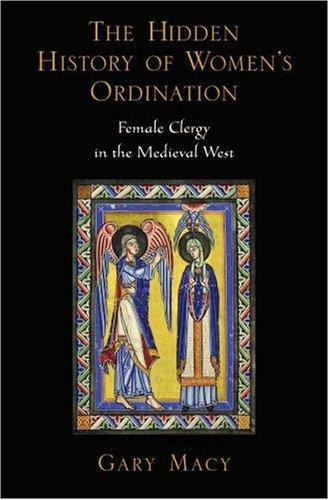
The Hidden History of Women’s Ordination
by Gary Macy
Buy on AmazonWe are talking about very early Christianity here and it is a much neglected field of study to which Gary has contributed a great deal of scholarship. He is very balanced and doesn’t come to any conclusions for which there is no evidence. But he does point out that women had a much stronger role in the early church than the official versions tell us. Women were working as priests and possibly bishops in the early church. He doesn’t say there were definitely female bishops but I think there were. So if you want a book which pulls together all the evidence of what was actually going on in the church, it is a fantastically robust volume because this is the kind of topic that you can’t mess around with. He is great at putting all the evidence on the page. I think there is an initial killer blow, in that once Christianity becomes the official religion of the Roman Empire it means it suddenly goes from being a fledgling faith, which is primarily to do with social justice and nurtures women and their role, to something that has a massive territory and militarised infrastructure to call its own – it has soldiers and garrisons. The emperor is the head of the army and he is one of the key players and so it becomes a militarised religion rather than one that is standing outside society and trying to get in. That is a bit later, but the foot soldiers of Christ had more muscle than the priestesses of Christ. In Divine Women we interview an academic from Oxford who has collated 53 volumes on the women of Islam and there are thousands of named women there over the early years. He found huge numbers of women who not only taught the basic precepts of Islam but actually preached in the mosques of Medina, Cairo and even Jerusalem, which is a hugely different picture to that which we are used to of women being segregated in mosques and certainly not allowed to stand up and speak in them. But, actually, women were preaching. I think it is a mixture. Men were writing the books and that might be one of the reasons it has taken so long to come to light but also exactly the same thing happened to Islam that happened to Christianity. It went from being a radical new idea to something that is very consolidated and is as much about temporal power as spiritual power. That was a world which was run by men in secular terms so it was very easy to sideline the role of those early women. But if you go back to the early teaching of Mohammed, the scholar we spoke to from Oxford believes that those teachings envisaged a world where women did take a prominent role. If you look at all the deities of wisdom that there have been in the world, over 90% of them are female. So obviously, through time, people have thought that wisdom is something that belonged to the female of the species! I think that women do have the capacity for wisdom, which has been underplayed, and, thank goodness, increasingly we are allowed to give voice to our ideas. And maybe what our role is going to be is to act as a conduit for the divine force that is wisdom. Get the weekly Five Books newsletter But who knows what will happen in organised religion. I’m not a prophet so I don’t know. But there is the notion that wisdom is something that binds the world, and makes us love it and not hate it. I think that if women are allowed to give voice to those ideas they can be their own kind of divine women.