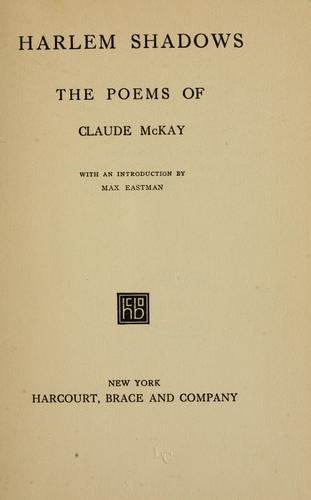
Harlem Shadows
by Claude McKay
Buy on AmazonHarlem Shadows comes first because it is a book of many firsts. It was the Jamaican-born McKay’s first and only American poetry collection; the first substantial poetic volume, if not the first published book, of the Harlem Renaissance; and more self-indulgently, the first work of McKay’s I fell in love with, the book that sparked my edition of his Complete Poems and later, the first publication of Romance in Marseille —the lost McKay novel I reconstructed with Gary Holcomb. Harlem Shadows would be worth listing here for just one of its ingredients: the influential, often mythologized sonnet “If We Must Die.” Its stately Shakespearian lines, forged in the race riots and labor wars of 1919, were received as the New Negro’s call to arms. “If we must die,” urges McKay’s unfazed and unracialized speaker, “let it not be like hogs / Hunted and penned in an inglorious spot.” “The Harlem Renaissance was the rare avant-garde movement comfortable with formal variety” But much of the collection captures McKay at the height of his invention in either prose or poetry. At its ironic best, it transplants enabling rage into the heart of the sonnet form, its fourteen-line formula first among “the older traditions,” McKay rationalized, “adequate for my most lawless and revolutionary passions and moods.” Published in experimental modernism’s wonderful year of 1922, Harlem Shadows dramatizes what became the Renaissance’s contrary habit of reinvesting standard-issue, seemingly white forms with groundbreaking Black content. Less generically, the collection reflects the simultaneous presence of Black Marxism, Caribbean immigration, nostalgic pastoralism, and breakneck urbanization on the Harlem scene. The Pulitzer Prize-winning poet Jericho Brown is not the only recent reader to note that none of McKay’s varied love poems in Harlem Shadows “would have been written if he had not been queer.” Alongside its other firsts, the collection qualifies as early testimony that the Renaissance would be, in the words of Henry Louis Gates, “surely as gay as it was black”—and not “exclusively either of these.”