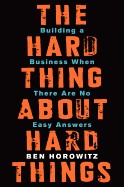
The Hard Thing About Hard Things: Building a Business When There Are No Easy Answers
by Ben Horowitz · 2014
Buy on AmazonBen Horowitz, cofounder of Andreessen Horowitz and one of Silicon Valley's most respected and experienced entrepreneurs, offers essential advice on building and running a startup—practical wisdom for managing the toughest problems business school doesn’t cover, based on his popular ben’s blog. While many people talk about how great it is to start a business, very few are honest about how difficult it is to run one. Ben Horowitz analyzes the problems that confront leaders every day, sharing the insights he’s gained developing, managing, selling, buying, investing in, and supervising technology companies.…
Recommended by
"For me, this book is a paean to founders, about the mix of practical skills and emotional resilience you need to start and run a company. Ben Horowitz is legendary these days because, along with Marc Andreessen, he was the co-founder of Andreessen Horowitz, which is probably the most important venture capital fund in the world. But when he wrote this book, he and Marc had been through a rollercoaster at a company called LoudCloud. LoudCloud was the innovator of this idea of putting servers ‘in the cloud’ where everybody could use them. It changed the internet—these days, Amazon, Google, and Microsoft all run massive cloud businesses. Unfortunately, LoudCloud was a horrible failure because all their customers were startups, and when the dot com crash happened all their customers went out of business leaving them with data centers full of servers that nobody was going to pay for. They managed to sell the cloud business for almost nothing and started selling the software they used to manage those servers. They barely stayed alive but finally went on to sell to HP as a software company. It’s a legendary pivot. Through this process Ben, as CEO, learns incredibly hard-fought management lessons. He starts sharing them on his blog. It’s things like: ‘How do you hire an executive?’ ‘What do you need to interview for?’ or ‘I hired this person who came from a big company and within days of joining my little startup he was rejected by the system—total culture clash. How do you avoid that?’ Eventually, he decided to turn the blog into this book. One thing Ben captures that every entrepreneur will identify with is the emotional journey of a founder. Ben says that there are only two emotions a founder experiences: terror and euphoria, often at the same time. And it’s true! Another great concept he shares in the book is about the entrepreneurial mindset. The probability that any startup will succeed is extremely low. If you just look at the statistics, you’d be crazy to launch a startup. But startups aren’t statistics, they’re calculus: there is an answer, and you just have to find it. Your job is to be the one in a hundred. In other words, this isn’t a random chance: you can figure it out—and if you don’t, you will be a statistic! To be an entrepreneur you have to be almost strategically irrational. He doesn’t say crazy, but he does say there’s an irrationality in believing that you can find that one out of a hundred. You also have to be deeply pragmatic about this, and that’s why there’s euphoria and terror at the same time—because what if you don’t find it? Ben even makes this emotional rollercoaster into a graph: you feel good for a while, and then horrible for a while because you learn something or the market changes. “If you just look at the statistics, you’d be crazy to launch a startup” When I was starting AppNexus I had the chance to meet Marc and Ben, before Andreessen Horowitz, when they were still at HP after the sale. I pitched my big idea—a cloud computing platform for advertising—and at the end they looked at me and said, ‘This is a terrible idea. We tried this at LoudCloud. You don’t have enough money to compete with the big guys like Amazon. They’ll crush you with their access to capital.’ So I said, ‘Okay, thanks for meeting me.’ And they said, ‘No, no, we want to invest,’ and I was like, ‘Why would you want to invest after telling me that?!’ And they said, ‘Well, most people walk in and are optimistic as all hell, saying ‘this is going to be the biggest business of all time.’ But you walked in and told us you know how difficult this is all going to be. The people who think it’s going to be great, when they hit the hard things and it turns into a struggle, don’t know what to do. You’re telling us you’re ready for it to be a struggle from day one. That’s the mindset of great founders—they’re built for and build for the struggle.’ That is the mindset of this book: starting a company is about the inevitable hard things, and if you’re willing to go through it, and you have the skills to learn and do all the things, you’ll find a way. By the way, Marc and Ben were right: my cloud computing concept was a terrible idea. We pivoted, though, and found a better business, and AppNexus was a huge success. I think self-awareness and this deep ability to handle big and often conflicting emotions at the same time is critical. You’re going to be afraid, and if you’re not then you’re doing something wrong. And sometimes you’re going to be euphoric, and if you’re not you’re definitely doing something wrong! But you can’t get pulled too far in either direction. There’s a great book by Andy Grove called Only The Paranoid Survive , which we won’t talk about, but that’s the idea: that there is a certain level of paranoia you need to have every day but you can’t let it overcome you, or no-one will do anything. This is what it feels like to be an entrepreneur."
Running a Business · fivebooks.com