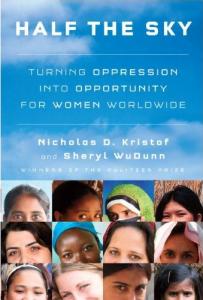
From two of our most fiercely moral voices, a passionate call to arms against our era's most pervasive human rights violation: the oppression of women and girls in the developing world.With Pulitzer Prize winners Nicholas D. Kristof and Sheryl WuDunn as our guides, we undertake an odyssey through Africa and Asia to meet the extraordinary women struggling there, among them a Cambodian teenager sold into sex slavery and an Ethiopian woman who suffered devastating injuries in childbirth. Drawing on the breadth of their combined reporting experience, Kristof and WuDunn depict our world with anger, sadness, clarity, and, ultimately, hope.They show how a little help can transform the lives of women and girls abroad.…
"Sadly, in much of the world life is not better for women and girls. But I think there is a growing awareness in developing countries and I have seen clear evidence of that. There are strong women everywhere and many, even in the most remote corners of the world, are taking a very strong stand. Still, too many women and girls are sentenced to a life of hardship, deprivation and oppression. Women across the world are doing so much of the labour without having any rights or reaping their share of the profits. There is a tragic lack of respect for women and girls and a failure to see women as being equal to men. “Three per cent of us will run away and not want to kill. Two per cent will stand up and risk everything to help others, and 95 per cent of us are capable picking up a machete and hacking strangers.” You may have seen in August how women, girls and babies too were raped in the Congo in one incident. This sort of brutality is not focused on a specific woman but it is a fundamental lack of respect for all women. Obviously, this must change. Change will come through education. I mean, I have been in conversation with women and asked – how many women were in your village before it was destroyed? And all too often the women will say: ‘Well, we don’t know numbers, ask the men – they know about numbers.’ It is not because they are not brilliant, which they are, or courageous, which they are. But, because of the way they are brought up, they think they don’t need to know, and they defer to the men. And the men assume they have that right. But this is beginning to change. Yes, and we have seen that in different ways at different times in different countries. I mean, in my own country here in America, not that long ago African Americans were not regarded as a full human beings. They were denied the rights available to white people. Even the Founding Fathers reflected this. The right of American women to vote was not passed until 1919. Even I grew up in a generation where women on TV were largely in the kitchen. Yes, I was recently at a youth conference in Uganda where there were equal amounts of young men and young women who were extraordinary and they were discussing the Millennium Goals and the best ways to go about realising them in their respective countries. But the striking thing was that they themselves represented the force and strength that will be needed. There were young people who were already reaching out in their communities. Also, an unsung and invaluable influence in remote areas of many of the countries I have visited are the aid workers themselves. Often they are women and they are working in positions of authority; organising, distributing, meeting people’s needs. Men have told me they have found themselves compelled to rethink their views of what a woman is because of the aid workers. There are signs of the beginning of change but it won’t be fast enough for my satisfaction. In my view patience is hugely overrated. I am not sure it is a virtue at all! Again, we come back to the goal of education. Change won’t happen without education."
"Half the Sky was one of the tipping points in the discussion of how we re-energise the women’s movement and expand it to a mainstream audience that is more inclusive of women and men; individuals who are deeply concerned about global issues but who have not necessarily been aware about women’s issues before. This book elevated the topic of women’s rights and made it acceptable for every woman and man to read and to have that ‘Oh my God’ moment, where they say, ‘This should not be acceptable. Women shouldn’t be treated like this.’ If I look at the recent modern history of the women’s movement I would say that Half the Sky is one of the few pivotal books that really changed the movement from just being confined to activists to something more universal. What I love about it the most is this idea that if the 19th century was about stopping slavery and the 20th century was about civil rights, the 21st century is about women’s rights. The awakening and realisation of that call is very exciting and they do this so movingly through the personal stories of all the women they meet."