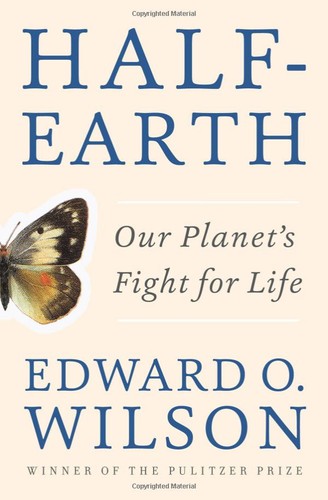
Half Earth
by Edward O. Wilson
Buy on AmazonHalf-Earth proposes an achievable plan to save our imperiled biosphere: devote half the surface of the Earth to nature. In order to stave off the mass extinction of species, including our own, we must move swiftly to preserve the biodiversity of our planet, says Edward O. Wilson in his most impassioned book to date. Half-Earth argues that the situation facing us is too large to be solved piecemeal and proposes a solution commensurate with the magnitude of the problem: dedicate fully half the surface of the Earth to nature. If we are to undertake such an ambitious endeavor, we first must understand just what the biosphere is, why it's essential to our survival, and the manifold threats now facing it.…
Recommended by
"I simply love the title of this book. It proposes that the situation facing our planet in environmental terms is so dire it can only be solved by dedicating half the earth’s surface to nature. It’s bold, it’s prescient and it hammers the message home: the biosphere does not belong to us, and if we ignore it, we will eventually, inevitably, become the perpetrators of our own extinction. I particularly appreciate his rebuttal of the ‘anthropocenists’ – those who believe we can solve our ecological crisis by high technology alone, that we can invent our way out of this mess. Wilson is a giant amongst biologists and understands biodiversity – and our impact upon it – like no other. So his words carry great traction. He is also a wonderful writer and one of those rare scientists who can communicate his inestimable knowledge with clarity and humility to the rest of us. I hope, more than anything, that the idea of ‘half earth’ is with us to stay. Within the next 25 years – the time-frame for the government’s 2018 Environment Plan – rewilding will have reconnected large swathes of the British countryside. The wildlife in our nature reserves will be spilling out into the wider landscape. In fact, we’ll be beginning to realise we may no longer need these expensive, intensively maintained oases, these Noah’s arks. We will have sewn Quammen’s carpet back together. The rewilded land will cross a multitude of spectrums. So the building blocks for a wilder Britain will be in place and enthusiasm for it will have been secured because within a very short space of time people will have seen the successes for themselves, both in terms of wildlife and ‘ecosystem services’ like soil restoration, air purification and flood mitigation. We won’t have ignored the call for a north-south connection, and corridors and stepping stones will be providing wildlife with the means to return to even our most denuded farmed landscapes. Get the weekly Five Books newsletter Beavers will be here to stay, with a management programme in place allowing people to feel confident that they can live with this keystone species once again. Other charismatic species, like white storks, sea eagles and eagle owls will be flying over us once again. The burbot will be swimming in our rivers after an absence of centuries. We might even have lynx in our most forested areas, keeping the roe deer in check, and viable populations of wild cat. And as the hockey-stick graph of species and biomass continues on its rising trajectory, we’ll be feeling the tangible effects of life renewed. A walk or a run in the countryside, even in areas closest to our cities, will be rich with wild encounters. Nature conservation will have risen to the top of the political agenda thanks to a deeper understanding of how our health, our prosperity, agriculture, our very survival into the future, depend upon it. And we will be looking with renewed confidence and vigour to an even wilder future."
Wilding · fivebooks.com