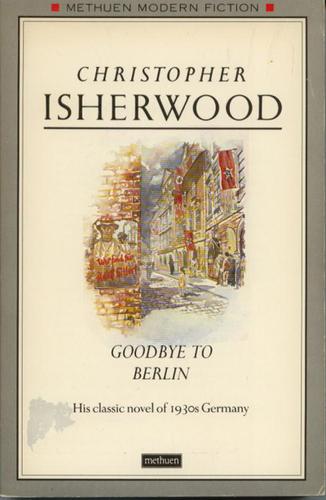
Goodbye to Berlin
by Christopher Isherwood
Buy on AmazonThe sequel to Mr. Norris Changes Trains, this is another semi-autobiographical account of Isherwood’s experiences in pre-war Berlin. The author leads the reader on a thoroughly entertaining tour through the seedier side of a particularly decadent time in that city’s history.
Recommended by
"That’s such bullshit! Christopher Isherwood is such a fascinating example of how complicated autofiction can be. In Goodbye to Berlin , he foraged from his own life to write a semi-fictionalised version of his own experiences, at first sexual and domestic and then political, in Weimar/Nazi-era Germany. But then, he writes this second book called Christopher and His Kind , in which he doesn’t use the first person. He has a character called Christopher, but what he’s actually doing in that book is unpicking the ways in which he invented and circumnavigated the truth in the first book. So I wanted Goodbye to Berlin as my first example partly because it’s the base text for Crudo . But, also, because I love the way that the more dishonest book uses ‘I’ and the less dishonest book uses ‘Christopher’ as an avatar. I think it’s such an old form. I don’t even want to speculate about where it starts because clearly Melville does it, and Proust. What writer doesn’t draw from their own lived experience? But, I think what is really interesting to me about Christopher, and maybe makes him the beginning of this legacy that I might try to fit Crudo in some way into, is that what he’s trying to do is document a domestic, erotic, intensely personal life and to show how it exists alongside and is eventually subsumed by a larger political reality. “What writer doesn’t draw from their own lived experience?” He’s not just writing out his diary; he’s using his own ultra-personal experience to try to get at what it feels like to inhabit the very beginning of what became seismic change in the world. To me that’s what’s most exciting about Goodbye to Berlin . It’s not so much about his experiences in the KitKatClub—although I love all that stuff—as how fascism can appear in a regular, ordinary society and how it can start seeping into every element of existence. I don’t think it’s passive. I think it’s very deliberate, active reporting. I’m working on a new book that is in part about Berlin just before the war, and Isherwood’s accounting is so exceptional. There’s this beach trip that happens in Goodbye to Berlin and then, again, in more diaristic way, in Christopher and His Kind . He describes hanging out on the beach each day and seeing people with little swastika flags around their beach encampment, and then noticing that someone has spelled out ‘Heil Hitler’ in pine cones. It’s a weird moment, the absolute cusp of change, and he catches it. You can feel people thinking, well, this could go in any direction, probably this is nothing and it will fade away. And yet, by the end of the book, Jewish department stores are having their windows smashed, and Christopher’s friends are being taken away and tortured. So he uses this very intimate tone in order to show you how fascism actually began. Yes. I was trying to write something that was about violence and sexuality. And I couldn’t do it. I was starting to realise that the moment was shifting so rapidly that I couldn’t get the perspective I need to write the sort of nonfiction I normally write. That left me feeling very—jammed. At the same time I was reading Chris Kraus’ Kathy Acker biography, After Kathy Acker , and it described how Kathy Acker would go to the library, take a book, steal the contents and transpose it into the first person. That excited me. I thought: hold on, this might be a way through. If I can take this character, if I can steal ‘Kathy Acker’ as a perspective and apply her ‘I,’ her consciousness, to the moment that I’m inside, perhaps I can use that to accurately record what it feels like to inhabit this moment of intense political change. The idea—and this is also why I wrote it in real time—was to try and capture a moment as it unfolded in front of me, rather than writing a historical, objective account of a moment after it happens. I think that’s what’s exciting about Christopher Isherwood’s “I am a camera” idea. It’s not so much the neutrality or the objectivity, which I don’t think he’s trying to do anyway, because it’s not a particularly neutral or objective account. It’s more the idea that you are opening a lens, you’re opening an aperture, and you’re allowing the world to roll in front of it. And then look at it at a later date. Expose it at a later date. That’s what feels exciting to me about Isherwood."
The Best of Autofiction · fivebooks.com