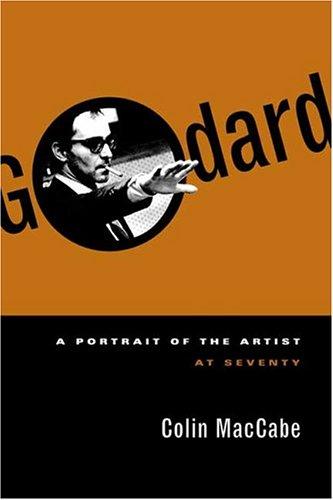
Godard
by Colin MacCabe
Buy on Amazon"Jean-Luc Godard's early films revolutionized the language of cinema.…
Recommended by
"When one looks back over the history of French Nouvelle Vague or New Wave there are so many outstanding figures: Truffaut, Rohmer, Rivette, Chabrol. They have had a formidable impact but Godard was really the wunderkind and representative of the group. This year is the 50th anniversary of Breathless and there is a major reconsideration of his work. Godard was not French but Swiss. But he did work in Paris. He made a controversial decision shortly after 1968 basically to stop making narrative films which one might say were pleasing to an audience. Instead he engaged in a kind of guerrilla film-making which he named after the Russian film director Dziga Vertov and formed with a friend, Jean Pierre Gorin, who was a Maoist activist. So we have this rather divided legacy of Godard. We have the early wonderful seductive lyrical films such as Breathless which has become iconographic in the history of French Nouvelle Vague and then there are other films like the ones he made with his wife, the actress Anna Karina. And then he transitions to these political films which have influenced my work. For example, one of them is called The Wind from the East which is the title of my book. In 1967 he made a very influential film on Maoist thought and politics called La Chinoise . The Left Bank is a small geographical quadrant and when an outstanding director like Godard explores the ins and outs of Maoism, it has a tremendous ripple effect. I have spent a lot of time probing what it was because it didn’t happen everywhere in the West. By 1967 de Gaulle had been in office for nine years and the zeitgeist was blowing left. Maoism fitted right in with the attitudes against what the Americans were doing in Vietnam. At the time the French left felt that all the traditional political options they had explored didn’t work. French socialism had collapsed and the true nature of Russian Communism had been exposed in 1956 with the crushing of the Hungarian Uprising and again in 1968, in case anyone had any doubts, with the crushing of the Prague Spring. And people were desperate for a Utopian political alternative. There was discontent with western civilisation and a depletion of energy all around. In 1966 Mao launched this youth-inspired Cultural Revolution with young students as Red Guards leading the charge. It was very hard for people in the west to get accurate information about what was going on there so they used it as a projection screen to entertain their own revolutionary fantasies about the last left-wing Utopia on the planet. That is the spirit in which Godard undertakes his investigations. He admires the revolutionary energy coming out China that was nowhere else to be found."
France in the 1960s · fivebooks.com