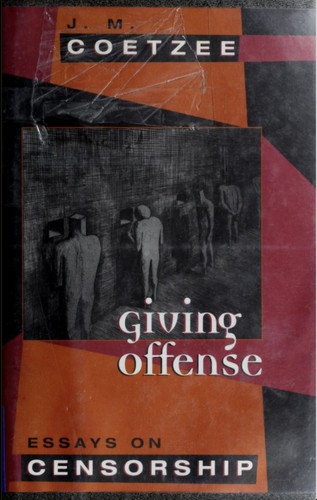
Giving Offense: Essays on Censorship
by J M Coetzee
Buy on AmazonThe reason I chose this is that so much of the literature on free speech is either law or philosophy or politics. Here is a writer, a very fine writer, going at it through literature, and what is literature about if not free speech? How we use language, how we interact. What’s so interesting about it is that he looks at the mental state of being offended, and he looks at it with examples from Dostoevsky and Dickens and elsewhere. He says the state of being offended is always the mark of someone who’s unsure of their own position, it’s a mark of weakness. It’s the mark of the bully and the buffoon, and I think that’s a very powerful insight. In saying, ‘I am offended,’ you’re revealing something about yourself. “The state of being offended is the mark of someone who’s unsure of their own position” If I extend that story and think about South Africa, I don’t think Nelson Mandela ever took offence—although heaven knows he had reason to be offended by the treatment he was receiving. He maintained his dignity. His position was, ‘You’re the people who are being diminished by this, you’re the people who are losing your dignity, not me.’ This goes against the grain of much contemporary western society, as one sees it in universities and elsewhere, which is almost incitement to take offence. People are being encouraged to take offence at anything they find slightly offensive. Even, for example, Germaine Greer being invited to lecture at a university: ‘I take offence because of her views on trans people.’ Free speech is also about what kind of people do we want to be? What kind of people do we want our children to be? Do we want them to follow the example of Mandela, or Václav Havel or Aung San Suu Kyi as role models and say, ‘While you’re trying to humiliate and degrade me, you’re humiliating and degrading yourself.’ Or is your role model the person who’s going to say, ‘I’m offended, I’m offended, I’m offended.’ But also, language, literature. Again, Amos Oz and Coetzee are about the same thing. How do we use this defining human gift, which is language—no one else in the animal kingdom has it—to negotiate our differences without coming to blows? That’s essentially what it’s about.