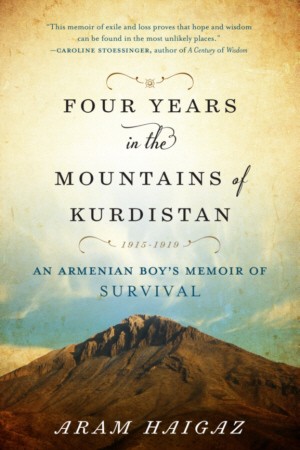
Four Years in the Mountains of Kurdistan
by Aram Haigaz
Buy on AmazonFour Years in the Mountains of Kurdistan is a remarkable first-hand account by Aram Haigaz, an Armenian author and youthful survivor of the Armenian genocide of 1915. This memoir has been made available in English in time for national publicity surrounding the 100th Anniversary of the Armenian Genocide. Armenian Aram Haigaz was only 15 when he lost his father, brothers, many relatives and neighbors, all killed or dead of starvation when enemy soldiers surrounded their village. He and his mother were put into a forced march and deportation of Armenians into the Turkish desert, part of the systematic destruction of the largely Christian Armenian population in 1915 by the Ottoman Empire.…
Recommended by
"Well, obviously this is both an Armenian story and a Kurdish story. It’s newly published family memoir which is now in English. I found it fascinating. I should start by saying that all these authors – or protagonists – were born at pretty much the same time, all around 1900, or a few years after; they were all children during 1915 but they all have very divergent experiences. Some of them manage to make it to the States, one makes it to Russian Armenia, the Soviet Union, one is completely absorbed into a Turkish family – who we’ve discussed – and then this extraordinary story, of an Armenian boy who lives as a Kurd for several years, in his teenage years, and is absorbed into this Kurdish household. It’s a vivid portrait of a mountain Kurdish community living in this pre-modern state, very beautifully observed. It’s told by a young boy who is very aware of his Armenian identity and is looking for chances to get away, which he eventually does at the end of the First World War in 1919. He escapes and re-finds his Armenian family. So it is the same story trajectory but with this extraordinary portrait of a Kurdish community in the middle. Support Five Books Five Books interviews are expensive to produce. If you're enjoying this interview, please support us by donating a small amount . At the end you’re getting the beginning of the next phase of violence and conflict in this region. The Kurdish rebellions are already beginning. First the Armenians are targeted by the Ottoman state and then it’s a matter of a Kurdish-Turkish fight, which then erupts in even greater force in the 1920s. Yes. If we take a step back, we’re looking at this enormously dramatic and tragic story in 1915, which later became known as the Armenian Genocide: the story of how the entire Armenian population of the Ottoman Empire – with a very few exceptions – was targeted by the Young Turk government in Istanbul during the First World War for deportation. Of course this had multiple effects and – in a few cases – armed resistance, which is Aram Haigaz’s story and, to a certain extent, the story in the novel about Van by Gurgen Mahari: Burning Orchards."
Memoirs of the Armenian Genocide · fivebooks.com