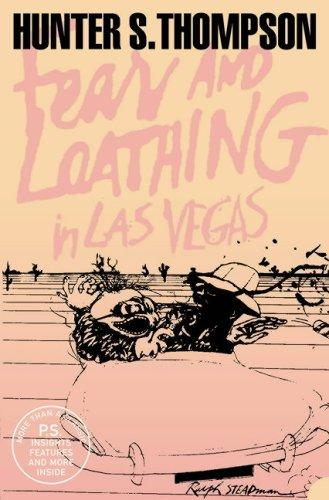
by Hunter S. Thompson
Maverick author Hunter S. Thompson introduced the world to "gonzo journalism" with this cult classic that shot back up the best seller lists after Thompson's suicide in 2005. No book ever written has more perfectly captured the spirit of the 1960s counterculture. In Las Vegas to cover a motorcycle race, Raoul Duke (Thompson) and his attorney Dr. Gonzo (inspired by a friend of Thompson) are quickly diverted to search for the American dream. Their quest is fueled by nearly every drug imaginable and quickly becomes a surreal experience that blurs the line between reality and fantasy. But there is more to this hilarious tale than reckless behavior, for underneath the hallucinogenic facade is a stinging criticism of American greed and consumerism.
"It’s one of my favourite books and probably my favourite Las Vegas-related book. Hunter S Thompson came out here in the early 70s to cover the Mint 400 off-road race for Sports Illustrated . He ended up writing a 10,000-word riff on his visit. In 1971, Jann Wenner ultimately published two long sections of it in Rolling Stone . Those two stories were the foundation for Fear and Loathing in Las Vegas . We have so many reporters that parachute into town, spend two to three days on the Strip and think they know enough to write the definitive piece about Las Vegas. Thompson came out here for weeks at a time and was able to capture the essence of the city. The language is raw and unique and funny and I just think it’s a masterpiece, an American classic . I was talking about this with another local writer a month or so ago about how people think “gonzo journalism” is a popular genre. I agreed with this writer that, although many had tried it, no one but Thompson could pull off gonzo journalism. Thompson was able to write himself into the stories that were real, raw and profane. He, along with his illustrator Ralph Steadman, created this hybrid of journalism and fiction. When I was working at the local alternative weekly City Life I came up with the idea of using Fear and Loathing as a guide to what was left of the city Thompson saw, what had changed, and what never really was. I was a big fan of the book so I wanted to find traces of Hunter S Thompson’s Las Vegas. I called his publicist repeatedly to try to set up an interview. It was a long process – I had to keep calling her back and she kept saying, “Thompson likes the story idea. He’ll give you a call. What’s your deadline?” He was notorious for missing deadlines and he missed a few with me. I had given up on interviewing him for the piece when one morning the phone rang at about 1:30 and the guy on the other end said, “This is your neighbour Mr Jones, would you please get the goddamn music down.” I said, “I’m sorry I don’t have any music on.” The man said, “Just get the music down.” I said, “Look, man, it’s not my apartment.” He said, “Is this O’Brien?” And I said, “Yeah.” And he said, “Hunter S Thompson.” Support Five Books Five Books interviews are expensive to produce. If you're enjoying this interview, please support us by donating a small amount . We ended up speaking for about an hour. He was my tour guide to the city so I asked him questions about his time in Las Vegas and if stuff in the book was real or not real and what he remembered. It was a big thrill for me. I wrote a 7,000-word story, “Hunting Hunter”, about searching for traces of Hunter S Thompson in modern-day Las Vegas. It’s in my latest book My Week At the Blue Angel . He gave me really good anecdotes from his time out here but also asked me questions about what Las Vegas was like in my time, what the hep drugs were and stuff like that. A few things come to mind on that. The book is more than a drug trip in Vegas – it’s a eulogy for the counterculture of the 1960s and their American dream of changing the world, getting out of Vietnam and beating racism . But also Vegas, by the 70s, and into this new century, came to represent a place where you could go to get that American dream. Not just getting rich at the gaming tables. You could come out here with very little education, and maybe a chequered past, and get a job on the Strip in the service industry making more than $50,000 a year and be able to get a home in the suburbs with three bedrooms and a pool. Vegas was part of the American dream in that way for a while – but that’s changed with the recession. Vegas had a family tourism marketing push in the 1990s. “What happens here stays here” was a clear shift back to adult themes. People do come here to cut loose. As a local it can be annoying but at the same time we all realise that’s the reason why this unlikely city is here."