← All books
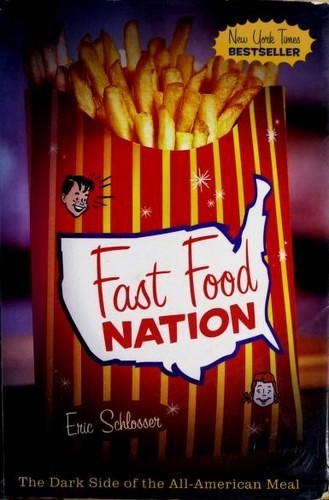
Fast Food Nation
by Eric Schlosser
Buy on Amazon
To a degree both engrossing and alarming, the story of fast food is the story of postwar Amerca. Though created by a handful of mavericks, the fast food industry has triggered the homogenization of our society. Fast food has hastened the malling of our landscape, widened the chasm between rich and poor, fueled an epidemic of obesity, and propelled the juggernaut of American cultural imperialism abroad. That's a lengthy list of charges, but Eric Schlosser makes them stick with an artful mix of first-rate reportage, wry wit, and careful reasoning. Schlosser's myth-shattering survey stretches from the California subdivisions where the business was born to the industrial corridor along the New Jersey Turnpike where many of fast food's flavors are concocted.…
Recommended by
"Eric Schlosser takes apart a single fast-food meal and shows not only how it affects our health but also how the people who serve it to you are treated. He also looks at how the people in the slaughterhouses working with the cattle are treated, and so it shows you the true picture of the all-American meal – burgers and fries. Yes, it has been 10 years since that book came out and I recently interviewed Eric Schlosser and asked him if things have improved and he said yes. People are getting much more aware of childhood obesity and the role fast food plays. And, certainly in the States, fast-food restaurants are required to give calorie counts, so people can see just how much sugar and fat are in some of these things. Eric said there had been a lot of progress on that front, but sadly the situation with the labour has got worse."
"Three books shaped my understanding of food and agriculture as a system: Fast Food Nation, by Eric Schlosser."
"This book again pulled together a lot of things I was hearing about in a journalistic, methodical, rigorous fashion. I found it a very alarming read, but also a reassuring one. One of the charges leveled at those who sing the praises of slowness is that we can get tarred with the brush of new ageism or airy fairyness. I’m not at all from that school. I’m a journalist and rigorous, and I know that Eric Schlosser is the same. Everything in Fast Food Nation is fact-checked. The first chapter in my own book is about food, because it seems to me the heart of the human experience. We consume it three or four times a day, and it’s very much part of our everyday existence. It’s something we put into our bodies to stoke the engine, but it’s also immensely political. Whenever you pick up a morsel of food on the end of your fork, you’re making a political statement about what kind of world you want to live in. There’s a story behind how that food got to your plate. You’re saying how you believe agriculture should work, how we should interact with the environment, not to mention all of the social and cultural aspects of food. Food is imbued with so much meaning for us, and not just in a Proustian sense, like Nigel Slater’s Toast. So the idea that something so precious and central to our experience has been spoiled by this cult of speed seemed to me a very powerful metaphor, and a useful door into the discussion of why slow is good. And it’s not healthy. The faster you eat, the worse it is for you in so many different ways. You miss out on the sensory pleasure of consuming food, enjoying all of the flavours and textures when you eat something with your full attention, as opposed to wolfing it down while checking your inbox. It’s important to find time to focus on your food, to eat and only be eating. That could be 15 minutes sitting on the park bench, or it could be a siesta and a bottle of wine after lunch. You have to tailor it to your schedule."