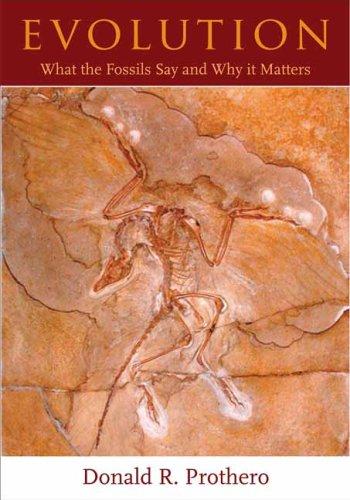
Evolution: What the fossils say and why it matters
by Donald Prothero
Buy on AmazonThis is the wildcard on my list, the one book that evolution aficionados might not have heard of. It’s important because it is the one book that really lays out in great detail, for the non-specialist, some of the strongest evidence for evolution, which is the fossil record. Don Prothero is a professor in California. This book is more like a textbook than any of the others. But it’s written in a popular style and is easily accessible to the layperson. If you doubted that evolution was true before, and then you looked at this book, I don’t see how you could possibly continue to question it. It’s stuffed full of figures showing fossil transitions, and descriptions of the evolutionary process. I found it fascinating and absolutely convincing. It supplements Darwin, who had almost no fossils. It just goes to show that the evidence for evolution is so strong and multifarious, and from so many disciplines, that even if you leave out one area – like the fossil record – the evidence will still be massive. Darwin did have some fossils and he used fossils in a couple of examples. But he had no transitional fossils showing the origin of major new types of animals. In his 1871 book [The Descent of Man] he says that it is more probable than not that the ancestors of humans were primates that lived in Africa. That was prescient, because they didn’t find those until the 1920s. Prothero’s book, more so than any book that is accessible today, fills in that missing evidence from Darwin. You can tell people about biogeography or embryology and how they attest to evolution, but in the end people like to see a good old fossil in front of them. There’s nothing like looking at an Australopithecus in a museum – something that has a human-like post-cranial skeleton with an ape-like skull perched on top of it – to really drive home the fact that there were these three and four-foot creatures that were half-way between us and our primate ancestors. This book is just full of them. And humans are just a small part of the book. It’s about the evolution of whales from land animals, of reptiles from amphibians, of mammals from reptiles and amphibians from fish. All of these major transitions in the history of life are documented. If you’re one of these people who likes to read Dawkins, Gould and Darwin, I would highly recommend Prothero’s book. I’d love to give it more publicity because it deserves a much wider audience. That’s probably true. Antibiotics have definitely been overprescribed. But, interestingly, there are no creationists when it comes to antibiotics. There’s a cartoon about that in Prothero’s book – a creationist opting for the drug that the bugs haven’t developed immunity to. But it’s more just a practical thing. If you’re a doctor, and a drug stops working because you use it too much and people become resistant to it, you stop using it. The theoretical basis is natural selection, but you don’t really have to understand that to take the proper action. I’ve always thought the practical applications of evolutionary biology to medicine are pretty overblown. My colleagues are going to kill me for saying that, but in general I think of evolutionary biology more as an adventure of the human spirit than as a way of making money or helping us get healthier. I really was not trying to produce any literary classic. But I was trying to show that when you understand how evolution works your appreciation of the world is immensely enhanced. That’s one of the great lessons from the books Gould and Dawkins have written. There are all these people who say that scientism and reductionism and evolution take away the wonder of the world. I guess their wonder comes from the contemplation of a non-existent celestial realm. But when you can see these material processes at work, and realise that it’s a true story – that we evolved from apes, that we did so largely by natural selection, and that we’re related to every other plant and animal on Earth – that’s the ultimate source of wonder. The world becomes so much richer when you understand how it got to be the way it is.