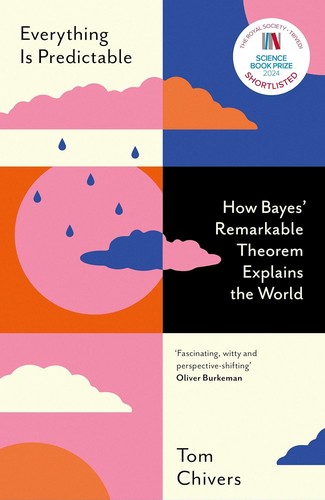
Everything is Predictable: How Bayes’ Remarkable Theorem Explains the World
by Tom Chivers
Buy on AmazonI wish I’d read this book years ago. Bayesian statistics is all over my area of research—and, as the book argues, it’s all over everywhere, and it has long been so. But the general public is not aware of this, and even many scientists, I think, are not aware of Bayes’ theorem. In a way, the book is pretty simple. It’s about one equation, which calculates the probability of something, given a piece of evidence and your confidence in that evidence. There’s a way you go through, calculating the probability of some event, adjusting your calculations as new evidence comes in—and that’s it, really. But the author does a great way of explaining how this is counter-intuitive to a lot of people. If you have a 1 in 80 chance of getting cancer, then we tend to think: well, that’s your chance of getting cancer. Actually, it’s more sophisticated than that. You also need to consider: what’s your chance of not getting cancer. So you think backwards, in order to think in a Bayesian way. He provides a lot of great examples. It’s a great counterpoint to what he calls ‘frequentist’ statistics, which is something we use all the time in statistics. Any time you see a p -value—the probability of something left to chance—that’s frequentist. If a p -value is less than 0.05, that means there’s only a 5% chance of it being explained by a random event. So that’s frequentist thinking. It’s how we tend to think. Bayesian statistics is against that kind of frequentist approach, it’s a totally different way of looking at things. I’m still coming to grips with explaining this to someone else; it’s challenging, and not intuitive. This is not a fault of the book, but a fault of the way my mind works, and the way we are trained to think about likelihood. I think it does help. Chivers’ point is that Bayesian logic is all about degrees of probability. There is no black or white thinking, it’s not ‘true’ or ‘false.’ You might never know something with absolute certainty. We might look around the world and see how many white swans there are, but we might never know if there is a black swan out there. But the more observations of white—not black—swans we make, the lower the likelihood of there being black swans. We are constantly building towards a vanishing level of uncertainty. You hear all the time about the latest health claims from science research. Red wine is good for you! Then: Red wine causes cancer! So, how do you adjust your beliefs with that new evidence? You adjust your slider for the probability of red wine being good or bad. That’s a kind of Bayesian thinking, ultimately. But it’s pretty challenging, because there is so much evidence pulling you in different directions.