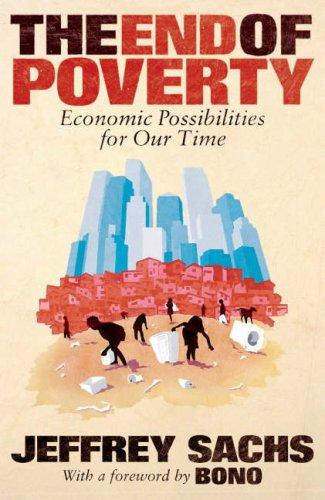
The End of Poverty
by Jeffrey D Sachs
Buy on AmazonA landmark exploration of the way out of extreme poverty for the world's poorest citizensAmong the most eagerly anticipated books of any year, this landmark exploration of prosperity and poverty distills the life work of an economist Time calls one of the world's 100 most influential people. Sachs's aim is nothing less than to deliver a big picture of how societies emerge from poverty. To do so he takes readers in his footsteps, explaining his work in Bolivia, Russia, India, China, and Africa, while offering an integrated set of solutions for the interwoven economic, political, environmental, and social problems that challenge the poorest countries.…
Recommended by
"I think Jeffrey Sachs gives a fascinating and very basic new way of looking at development. Essentially, we all benefit when the poorest people are better off. This is as opposed to the maniacal way of thinking that says if India and China are as rich as us there will be a global disaster. His research shows that this is simply not true. It’s a readable book because he weaves his journeys around the world into the argument of the book and it’s filled with very gripping stories of people living in desperate conditions in different places. It opens talking about Malawi…I was horrified to read that the government of Malawi put together a thoughtful and innovative plan to treat their huge population of Aids patients, and the international community kept cutting back and saying they didn’t have enough money. So they left them to die, when there was a carefully costed plan and something could have been done. Sachs shows a kind of out-of-the-box thinking that proves how richer nations will benefit when the poorest nations are better off. Because it reduces insecurity, disease and overpopulation. Educated people have fewer children in general and richer countries are more stable and less likely to be a threat. It’s win-win. I don’t understand why more people don’t get that. Well, there has always been this feeling that if, for example, China and India, become powerful, it will weaken powerful nations in the West. It’s a sinister mentality because, in fact, there is enough for everybody. The difference between the way wealthy people live compared to the way the poor live, even in poor countries – there is no reason for that. Sach’s book is engaging because it is not particularly sentimental. It’s written in a way that very clearly lays out why wealthy nations will benefit. It’s cold hard economic analysis explaining why moral economic policy makes sense. This idea is effectively the basis of counterinsurgency strategy being implemented in Afghanistan: that the best weapons don’t shoot. You won’t beat the Taliban and al-Qaeda by killing them all, but by making them irrelevant because you provide a better alternative. It is the same essential point. And it’s the basis of Three Cups of Tea as well."
The Afghanistan-Pakistan border · fivebooks.com
"The reason I put this on the list is because it is my understanding of what we can accomplish from the point of view of an economist, a pragmatist and somebody who is involved day to day in practical problem-solving. The book is an attempt to put forward this proposition that we have in our hands now the means to end extreme poverty within our generation. We are the first generation that can do this. This has been a goal for humanity which has been viewed as out of reach but we actually, literally and practically can do it, and that is because we are living in a period of astounding technological capacity, of great wealth and knowledge about systems such as food production – all of these are things which can solve extreme poverty. And I am trying in the book to set up a practical proposition by which, if we organise ourselves appropriately at local and global level, if we devote just a modest fraction of our vast wealth to this effort, not only will we achieve these development goals but we will also see our way to the end of extreme poverty by the end of 2025. And I believe that both goals are bold but realistic even though the world has a capacity to temporise. I argue both in this book and also in Common Wealth, the successor of this book, that ending extreme poverty not only, as the Dalai Lama referenced, would make us feel better and help us to achieve a higher level of happiness, but it would also help us to find a way to peace itself. This is because, as I explain in both books, the link between extreme poverty and conflict is a strong link. Most of the places in the world that are conflict zones or havens for unrest and even terror are very poor societies that have been broken by drought, disease and hunger. If we go to the fore of these challenges and help to solve them we will also find that we are achieving physical security as well by reducing tremendously the amount of conflict in the world. I think it is both the things that I have seen and the things that I have been fortunate enough to help do. One of the anniversaries of 2010 for me is ten years after I gave a speech in Durban, South Africa calling for a global fund to fight Aids, and within those ten years of working with Kofi Annan and many others that fund came into being. It helped to keep millions and millions of people alive who otherwise would have died. It became a fulcrum for malaria control and for TB control and it has been a way to show many sceptics what can be accomplished. There is still a big effort required to meet the needs of all people who are affected by HIV and malaria but the progress has been tremendous, and I can tell you, ten years ago, before this effort existed at all, people were saying it was all impossible. That shows what can be done and I have seen that kind of reality in so many places that I suppose that from experience as well as temperament I am bound to be an optimist!"
The Millennium Development Goals · fivebooks.com
"All these books are drawn from people that I have worked with over the years. Jeff came to me when I was head of the UNDP and we were talking about how we could get this real injection of political energy into achieving the so-called Millennium Development Goals. These goals promoted the basic global safety net of halving poverty, getting every boy and girl at least into a minimum of primary education and so on by 2015. He said, ‘What about if I assemble the world’s best experts and we cost out what it would take.’ Get the weekly Five Books newsletter So he did this exercise for the UN and it gave a huge plausibility to achieving the MDGs because it brought them from being just some empty, unrealistic ambition to something doable and practical. That work later became a big part of this book. It is a wonderfully powerful manifesto of how providing a basic global social safety net is an affordable and achievable objective. That fills out my vision of an accountable global society because it needs this kind of social safety net. My whole thesis is that it needs to be accountable and have something in it for everybody – even the poor. Jeff’s book shows it is doable in an economic sense, and that is a very important building block in all of this."
Globalisation · fivebooks.com