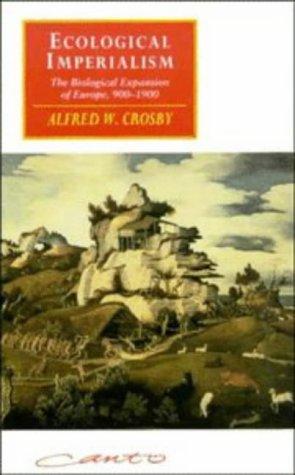
Ecological Imperialism
by Alfred Crosby
Buy on AmazonCrosby argues that the expansion of European culture and genetic stock was a function of ecology and biology over time rather than a result of quick and painful conquests.
Recommended by
"Alfred Crosby is a well known environmental historian. He became famous with a book called The Columbian Exchange , which deals with the spread of animals, plants and diseases between the Americas and the old world. What he does in Ecological Imperialism is take that idea one step further and show how environments influenced the relations between civilisations, especially between Europe and the new world – and how, in turn, contact between the old world and the new changed environments around the world. He shows how Europeans have established what he called “neo-Europe”, such as North and South America, Australia and New Zealand. In taking over those parts of the world, they changed the population from indigenous to European. He says that was done not by warfare so much as by the introduction of plants, animals and diseases. In North America, much of the food and most of the domesticated animals that we have, and the diseases that infect us, are almost all imported from Europe or the Eastern Hemisphere. Technologies were extremely important because they involved transplanting plants and animals. The damage for some people is a benefit for others. For the great majority of North Americans, it has been a boon. The same goes for the people of the Eastern hemisphere, who obtained a number of plants from the Western hemisphere in exchange. So the world as a whole is much richer and can support far more people as a result of the interactions and communications. I don’t think anyone wants to turn back the clock to the Middle Ages."
Technology and Nature · fivebooks.com
"Yes, this is an older book, the only one on my list published in the 20th century. Crosby is one of the truly foundational figures in environmental history, and one of the few who comfortably operates on a global scale. The same will be true of John Richards’ book; both are essentially global histories. Crosby’s book also has a very vigorous and much-disputed argument to it, to wit: that plants, animals, and pathogens were a powerful ecological component in that subset of European imperialism that historians now call ‘settler colonialism.’ The reason this is controversial in some quarters is because it can be read to exonerate European colonialism’s sins of violence—particularly the argument concerning pathogens. If smallpox and measles and influenza were killing people in the Americas and Australia, and other places, then perhaps it’s not so much a matter of European colonial violence. But I think that’s a misreading of Crosby. I think he acknowledges the role of violence, but he wants to draw attention to something historians hadn’t previously paid much attention to, and that’s the success of sheep, goats, cattle, bluegrass, wheat, barley as well as pathogens in remaking landscapes, particularly in the temperate latitudes of the Americas, Australia, and New Zealand, making these landscapes more familiar, more comforting, and more inviting to generation after generation of migrants from Europe. “If I regard two books as equally skilled in execution, the one that tackles the bigger canvas is usually the one I prefer” That’s the argument in Crosby’s book, and when I first encountered it I was mightily impressed and thought: Why didn’t everybody know this before? Pieces of it, of course, were known before, but Crosby assembled it into a coherent story more successfully than anybody had ever done before. Again, he wrote it in mellifluous prose that I, at least, found very enjoyable to read."
Environmental History · fivebooks.com