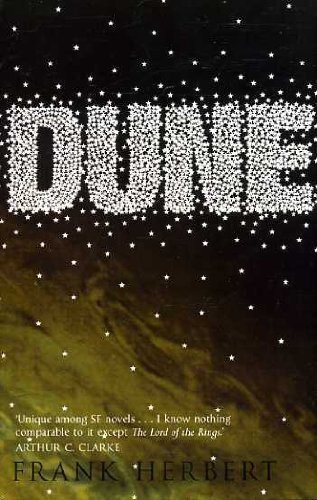
Dune
by Frank Herbert · 1965
Buy on AmazonSet on the desert planet Arrakis, Dune is the story of the boy Paul Atreides, heir to a noble family tasked with ruling an inhospitable world where the only thing of value is the "spice" melange, a drug capable of extending life and enhancing consciousness. Coveted across the known universe, melange is a prize worth killing for... When House Atreides is betrayed, the destruction of Paul's family will set the boy on a journey toward a destiny greater than he could ever have imagined. And as he evolves into the mysterious man known as Muad'Dib, he will bring to fruition humankind's most ancient and unattainable dream.…
Recommended by
"This sci-fi epic explores the complex interplay of AI, human evolution, and power structures, aligning with Lex Fridman's work on artificial intelligence and the future of humanity. Its philosophical depth and themes of consciousness make it an expected read for someone exploring the intersection of technology and the human condition."
Lex Fridman's Reading List · lexfridman.com
"Dune is very interesting because it marks the transition between pulp fiction planetary romance and engagement with real-world politics. It’s a story about a young nobleman whose family are assassinated, and he is driven into exile on a desert planet. He makes common cause with the warriors of the desert in order to try to come back and reclaim his inheritance. But as well as that basic ‘hero’s journey’ element, a lot of the book is very much tied up with the setting, the very distinctive ecology of Dune the planet, which, like I said, is mainly desert, but features amazing creatures like giant sandworms. The relationship between the human beings who have settled on the planet and the native creatures is quite fundamental to how they’re going to try and solve the political problem that they’re faced with. It was written at the height of the Swinging Sixties, but it’s addressing problems of ecology and environment that have become all the more salient today. In that way, it was quite forward-looking—as you would hope from a science fiction book—and it became particularly popular, I think, because it managed to carry it off awfully well. The pacing is partly adventure story, but partly written as a history of previous times looking back. It’s told in a convincing, mythical way. You’re given the sense that these are really important issues. It’s the first of a series of several books. I must say, I feel none of the others quite lived up to the impact of the first one, although I’ve had bitter arguments with diehard fans who tell me I’m completely wrong about this. Absolutely. I work in European politics in my day job; I’m a lobbyist in Brussels. This is intense and it confronts me daily with really important, high-level situations. I like a bit of escapism at the end of the day, but I also like something that speaks to my interests—which are politics and, increasingly, the environmental question which is becoming so important in the world. So yes, for me, it’s an escapism temptation. But also I like the sense of some intellectual heft behind it. Some emotional tug that brings you into the new invented world. I think that’s true of all five of these books that we’re discussing. Related book recommendations: Books Like Dune"
The Best Sci Fi Books for Beginners · fivebooks.com
"I felt like it would be weird to leave this off a list of political science fiction, both because of the particular cultural moment that we’re in right now, where there is a successful new film adaptation of Dune and a lot of people are coming to this book for the first time, and because it is probably a deeply influential novel for many of the writers we have already talked about – including me. Dune is a big sprawling space opera. It is explicitly a political book: it’s about a revolution to overthrow an oppressive emperor, but also about a conflict between two military families, and how they run extractive industries on planets. It’s also about religion. And it’s about trying to build better people through genetic or psychoactive means – all of which make a lot of sense when you think about who wrote it, and when he wrote it. Frank Herbert was writing in the milieu of MKUltra , and Edward Said’s Orientalism , and the first approaches for a lot of white Western writers to thinking about Islam as a cultural force. There are many debates on the internet – and you can go look for them, if you like – about whether Frank Herbert did a good or bad job at approaching those issues. What I find more interesting is that he wrote something that had a lasting impact, both on what other kinds of science fiction have been written, and on what other books in the genre of political science fiction are responding to. The cultural impact is bigger than readers and writers in the genre, because Dune is one of the ones that escaped confinement and got out into the wider world. It I read it probably far, far too young. I was maybe eleven, which is not the age I recommend reading Dune , unless you want to get a child like me – and I’m not really sure most parents want that. It’s hugely influential for me, as a writer, in terms of conceptualising complexity, and the way you can write a book about the moral injury of trying to work in geopolitics – about what kinds of psychologically horrific things can happen to a person, if they are trying to be a God Emperor, or trying to be a person with their hands on the wheel of fate. It’s very grandiose to say that, but in some ways that is what people who get into serious politics are trying to get their hands on – at least a very little wheel of fate. And Dune is not flinching about the things that happened to Paul Atreides, and the things that happened to his mother Jessica, and to Chani, and all the other people around him who are affected by the stone that he has thrown into the lake of the world. It’s also a book that is unafraid of doing a huge amount of scale. I think that’s something that shows up a lot in the genre, in responses to Dune that have integrated it or thought about it or just said, “I want to write Dune again because it was cool, and I want to do that!” – the sense that you don’t have to focus down really tight, you can get intergalactic in scope. And you can do it while having character and character interaction remain very central to the plot development of the book. My favourite character in Dune is actually none of the people I’ve mentioned, it is the planetologist Liet Kynes. He’s very important, and mostly a horrific cautionary tale about doing environmentalist work for an oppressor. But I love him, and someday I will figure out how to write the book that’s about him, which I never have! Related book recommendations: Books Like Dune All of that big plot, the enormous-development-of-the-fate-of-the-world plot: none of that would be occurring if there weren’t people making decisions. When you get deep into it, it turns out that the people making the decisions, and the people who are noticing the decisions being made, have emotional reactions – which then drive actions in the world, which influence that giant plot. So to me, if you’re doing it right, they shouldn’t be separate at all. You can do the very real situation of: ‘Oh God, the sweep of history has come for me at last’. That does happen to people, because there’s forces that are not localised in a single person or single event, but are macroeconomic or even made of physics like climate change. But even the responses to those big forces are rooted in the ways that humans react to one another, and their deep emotional responses to events. I think all of the books that I’ve listed are the kind of science fiction that I like to read because they are character-driven books, not concept or scale driven books."
The Best Political Sci-Fi Books · fivebooks.com
"Frank Herbert’s saga has so many different parallels in various philosophies in the history of the world. It’s huge, sweeping, vast, with so many different characters. Obviously, there’s allegorical connections to the Christian Bible and to several other hero-saviour journeys in various faiths around the world. So already, the book itself is carrying huge weight. The books have been around for such a long time that there are people who name their children after some of these characters. And so you’re given the task of narrating the book. What do you do at that point?"
The Best Sci Fi Audiobooks · fivebooks.com
"I’m guessing that most of your readers will know Dune – if only because it’s just been adapted into two enormously successful films. It’s the story of a young man, or boy really. When the story begins, he travels with his very powerful family to the planet Arrakis, known as Dune, which is entirely a desert world. He becomes involved not just in galactic politics, but in a struggle for freedom on behalf of the longest-inhabiting peoples of Arrakis, the Fremen, all centred around the production and ownership of a spice which allows space travel to be possible. I’ve just written a book called The Worlds of Dune , which is subtitled ‘The places and cultures that inspired Frank Herbert’. Essentially, Herbert spent five or six years reading before and during the writing of Dune, and he took inspiration from a vast number of sources: historical, cultural, religious, personal. So The Worlds of Dune was about rounding up all of those many, many influences and trying to lay them out in an approachable and reader-friendly fashion. “All of these novels are consciousness-expanding, or have been for me in one way or another” It’s extraordinary – I think one of the reasons Dune has always been popular is the richness of its invented world. And part of the reason that world is so rich is because so much of it is drawn from history and culture, particularly Islamic and Native American. But also Greek myth, Roman history, Zen, Japanese culture… there are just so many. And of course his love of science fiction as well! All of this got poured into the pot, and it ends up being one of the most complex invented worlds in science fiction, and one of the most immersive as well. Frank Herbert was a talker! He was a raconteur, and he loved to wax lyrical about his work and his ideas. He didn’t try to hide the places that he got his ideas from – for example, in Dune he lifts direct quotes from ecology books like Silent Spring by Rachel Carson. He pays direct homage to ideas of Zen bodily control, and he talked very openly about being inspired by the study of what was called general semantics, which was the idea that words and the way we speak them broadcast subtler meanings in addition to the obvious meaning of whatever we choose to say. That’s very important in Dune – the characters have the ability to use words in a way that can actually control another human being. And he was very open about the fact that this was derived from this now-overlooked area of general semantics, and imagining how that could develop 10,000 years in the future. Researching the book was just a case of listening to and reading a lot of interviews with Frank Herbert; reading the wonderful book Dreamer of Dune that his son, Brian Herbert, wrote about him; and reading a lot of scholarly essays on Dune , of which there are many wonderful ones. Then researching the actual histories and ideas, and compiling all of that in a way which was readable to the layman – to me, essentially! Related book recommendations: Books Like Dune"
The Best Science Fiction Worlds · fivebooks.com
"I read Dune because my son recommended it. He thought I would enjoy the dynastic element. I was looking for help with my novel, searching for a story that showed how to build a simple narrative within larger, socio-political themes. I didn’t find the simple narrative, but Dune left an indelible impression on me as a staggering work of science fiction. Herbert’s detailed and engrossing descriptions of life on planet Arrakis were so convincing, they left an actual stink on my palette. The spice..."
Favorite books · radicalreads.com
"Dune was both massive for me, and they both live comfortably between science fiction and fantasy."
By the Book: Leigh Bardugo · nytimes.com
"I’m sure someone else has said this before me: in lots of ways, Dune reads like science fiction written as fantasy. I’m not saying it’s not science fiction, but it adheres to a lot of the tropes and structures of epic storytelling and epic fantasy. You have knife fights and you have shields; you have lots of things that you could put in a medieval-style setting, and it would make perfect sense. So Dune gets put in that same category in my brain, of epic fantasy/science fiction. You have lords and armies, and fighting over resources – it’s of a type. And in fact, there are books that are the other way around. The Way of Kings by Brandon Sanderson , for example, is fantasy written almost like science fiction – because it’s on a different planet with a completely different ecosystem, and it’s all very well explained as you would in science fiction, even though there’s magic. Dune is the other way around: it’s a sci fi world that reads like fantasy, with archaisms and other tropes. It’s the story of a young man who is coming of age, acquiring his powers, dealing with tragedy, and having to face off against great opposition and prove himself as both a warrior and a leader. Personally, I also like the writing style, although some people can’t stand it. I remember one time I picked up Seven Pillars of Wisdom by T. E. Lawrence , and it’s Frank Herbert’s writing style – which makes perfect sense, because Herbert was writing about the desert and desert peoples, and was drawing a lot from real-world traditions for his own setting. I like his style: it’s wonky and distinctive, like all of these writers, and it creates a unique sense of place. From a technical world-building standpoint, something he does really well is evoke a much larger setting than he actually depicts. He’ll often mention something, a piece of technology or a piece of history, just as a throwaway line. This is something Jack Vance, the classic sci fi author, did a lot of as well. He’ll mention something, and then he won’t ever explain it any further. And when people talk about all the incredible world-building of the Dune universe and setting, ‘Oh, there’s this, and there’s that,’ and then you read the book – it’s not in there. It’s in the appendices, or it’s in the sequels. There’s a lesson there, I think, for modern writers, about finding the balance: not overloading the reader with exposition, while at the same time not confusing the reader. Herbert did a good job of walking that line."
The Best Epic Fantasy Books · fivebooks.com