← All books
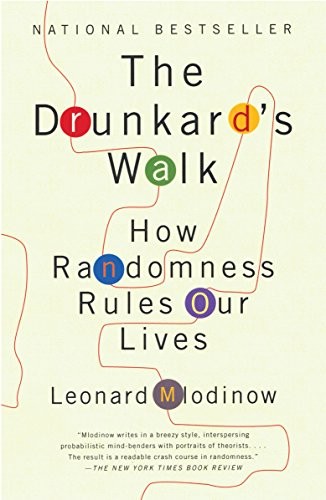
The Drunkard's Walk
by Leonard Mlodinow
Buy on Amazon
In this irreverent and illuminating book, acclaimed writer and scientist Leonard Mlodinow shows us how randomness, change, and probability reveal a tremendous amount about our daily lives, and how we misunderstand the significance of everything from a casual conversation to a major financial setback. As a result, successes and failures in life are often attributed to clear and obvious cases, when in actuality they are more profoundly influenced by chance.The rise and fall of your favorite movie star of the most reviled CEO--in fact, of all our destinies--reflects as much as planning and innate abilities. Even the legendary Roger Maris, who beat Babe Ruth's single-season home run record, was in all likelihood not great but just lucky.…
Recommended by
"This is a general introduction to the history of probability and the way it comes into everyday life. It intersperses the historical development with modern applications, and looks at finance, sport, gambling, lotteries and coincidences. It starts off with quotes from Cicero feeling that people were being misled by thinking that the gods influenced the throw of a die. Then it carries on through the early development of probability in the 16th century with mathematician Gerolamo Cardano. He threw two dice and looked at the distribution of the sum of the two faces. There was an incredibly popular game called Hazard where you threw two dice and betted on what the total would be. Amazingly, people had been gambling for centuries and had never realised you could do maths on gambling. Probability – which used to be known by the wonderful term “the doctrine of chances” – grew out of this. The book illustrates various issues in ordinary life. For example it looks at the gamblers fallacy, where if you are betting on something like roulette and red has come up more than four times in a row, the fallacy is that black must be due to come up. That isn’t true, as long as the wheel is fair. You get that in lotteries as well, where if numbers haven’t come up for a while people feel that they must be due – which isn’t the case as there is no memory in the system. He also covers coincidences, for example the fact that people do win freak lottery results, such as winning twice in a short period. Actually, these things are not unexpected if you take into account the number of opportunities for odd coincidences like this to happen. So he explores the different ways that probability can do strange things, which he illustrates very nicely with a whole lot of historical characters. As a final example he talks about Francis Galton, a rather strange but brilliant man who came up with the idea of “regression to the mean”. This is the fact that if you pick things when they are on a high for some reason, just by chance they are likely to come down. He uses the example of the supposed jinx of Sports Illustrated , which is the idea that after anyone appears on the cover of Sports Illustrated magazine, inevitably their career seems to suffer a terrible blow. He points out that this is really regression to the mean. The fact that you are on the cover means that you have had a run of good luck, but luck doesn’t last and eventually things average out."
"A wildly entertaining book about probability, which left me ultimately deflated by my complete ignorance of chance, or luck, and what an astonishing huge part that plays in our lives."