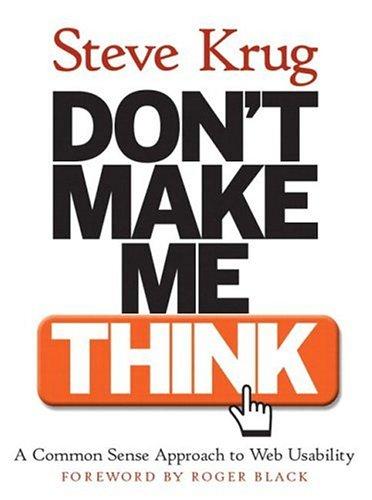
Don't Make Me Think: A Common Sense Approach to Web Usability
by Steve Krug
Buy on AmazonThis is a beautiful, short, funny little book about software usability. Usability is the art of communicating the point of software. In the modern world, a large percentage of our time is spent on apps, devices, phones, and on. It’s important to be able to understand how to build them and how to communicate your intent. If you can remove the reason for someone to have to think, that’s great. The book’s title, Don’t Make Me Think , is a beautiful summary of this idea. We think that complexity is good. For a lot of people, having so many options causes decision fatigue. It’s overwhelming. You can address this by removing a few of the options or presenting them in a particular order. If you have ten options, don’t present all ten options on the first screen. Instead of giving people everything up front, you might start by presenting two options. Then, depending on what the user selects, present two more options, and so on. The same principle may be applied to communication. Instead of giving people the entire picture or story up front, give them a high-level overview, and they can drill into more details as needed. Don’t Make Me Think presents examples of how to communicate what someone needs to do and how they need to do it, and software is a use case of how to do that. It comes back to providing the right analogy. While you can’t necessarily explain all the steps in perfect detail, you can give someone an analogy for what they need to do. I would compare this to giving someone a map as well as giving them directions. If you give me only directions and I make a wrong turn, I will have no idea exactly where I went wrong and it will be hard to backtrack. But if you give me directions along with a map of where I am going, I will understand why I’m going in this direction, down this street, around this obstacle, and across this river. If you provide the user with only the details, and you do not show them the big picture, they cannot build a mental model of what needs to happen. Providing the big picture makes the user more resilient. If they make a mistake, they will be able to understand what went wrong fundamentally, instead of only at the superficial level.