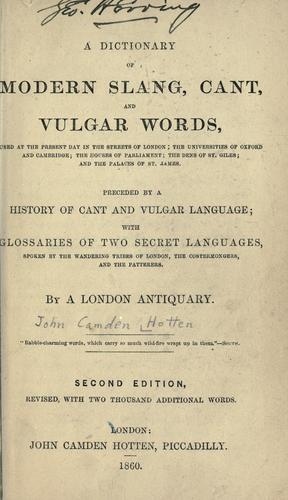
A Dictionary of Modern Slang, Cant and Vulgar Words
by John Camden Hotten
Buy on AmazonHotten is the first slang lexicographer to come up with a considered treatment of the history of slang and indeed of cant, or criminal slang. He also offers a history of back slang and rhyming slang. His is a substantial bibliography, which no one had done before him. No-one had ever written about slang in the way that Hotten did. His definition of slang is one of the best there is: “ Slang represents that evanescent, vulgar language, ever changing with fashion and taste, … spoken by persons in every grade of life, rich and poor, honest and dishonest … Slang is indulged in from a desire to appear familiar with life, gaiety, town-humour and with the transient nick names and street jokes of the day … Slang is the language of street humour, of fast, high and low life … Slang is as old as speech and the congregating together of people in cities. It is the result of crowding, and excitement, and artificial life. It is often full of the most pungent satire, and is always to the point. Without point Slang has no raison d’etre. ” If you want to find the starting point at which to look at slang, rhyming slang, back slang and a variety of other sub-sets, plus a very good assessment of what was available in terms of slang lexicography in 1859, then Hotten’s your man. He had a shop on Piccadilly where the Ritz Hotel now stands. He was a publisher. He was a bit of a plagiarist, or more of a pirate really. He published authors like Mark Twain. Of course, there was no copyright then. There was also his “flower garden”, which was pornography. Some say the pornography kept his business going. Others disagree. We don’t really know the answer. In all he produced about a million and a half physical books in the last 10 years of his publishing life, which ended in 1873. His firm was bought by his assistant Andrew Chatto and eventually became the firm Chatto & Windus, which exists today. One person came up with the line, after it was suggested that he died from a surfeit of pork chops, that this was proof that cannibalism was not a good idea. The joke being that he was pig and ended up eating himself. Others were more generous, saying he was a workaholic, helped authors and never made much money.