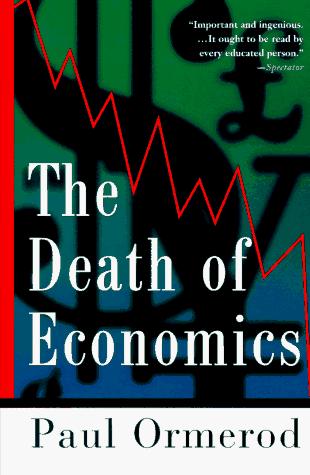
The Death of Economics
by Paul Ormerod
Buy on AmazonThis is the only book on my list that focuses on macroeconomics—the area of economics that looks at things like unemployment and inflation and the economy as a whole. Mostly macroeconomists are not thinking about the process of going to work or buying and selling stuff, they’re thinking about the big macro numbers that people talk about on TV. What I like about Ormerod is that he points out just how badly the profession has performed in this field. When I was first doing the subject, we thought that Keynes had solved all the problems. Before Keynes came along, there were people who thought they had the answers. Later, Friedman and the critics overturned a lot of Keynes, but then their own policies didn’t work either. So we’re in a state where we really don’t know very much about how the macroeconomy works. My view—and other people like Krugman’s view—would be that we had a pretty good demonstration in the last 10-15 years that the ideas underlying austerity don’t work very well. But there are still plenty of economists backing those ideas. Ormerod does a great job in alerting people to the fact that although lots of ideas are put forward very confidently in this sphere, the actual degree of support for those ideas isn’t as strong as you might imagine. Get the weekly Five Books newsletter The weakness in his book is at the end: he has a bunch of ideas about chaos theory and butterflies and so forth. It’s interesting reading but doesn’t seem to make much of an advance on the previous stuff. What the book emphasizes is that when the macroeconomy isn’t working well, when there’s lots of people unemployed and unemployed resources and so forth, arguments like Friedman’s, about how the micro economy is working and how particular markets are working, are also suspect—because we simply don’t know that prices are reflecting opportunity costs. And that’s a theme in my book as well. It reads as if it’s much more contemporary than it actually is. I read it when it came out and I reread it just now to speak to you, and it stands up very well in terms of the criticisms he’s making. There really hasn’t been much of a shift in the areas he’s talking about, indeed we’ve had another round of back and forth. After the global financial crisis, Keynesianism came back in, it worked pretty well in my view, but it was pushed out by the European Central Bank, by the Republicans in the US and by the Cameron government in the UK. And so we went through this long period of depression apparently having learned nothing since the 1930s. If you jump ahead to the other books, what we’re seeing is a retreat from not only esotericism but also from idealized theories which, even if they’re not very complicated, simply assume away a lot of realities—like real business cycle theory. Most of the other books I’ve chosen are much more grounded in data and closer to the realities of the world than was the economics of the late 20th century that Ormerod’s talking about, though I should say there’s still plenty of pointless theory going on, particularly in the area of macroeconomics. I try and do a bit of both. I can’t really get into macro because it’s this closed literature, so I try and approach it from various angles, and arm myself with lots of mathematics in order to speak the language. In the macro, what I’m trying to do is support an old-fashioned Keynesian view with more modern arguments. It’s not a venture in which I’ve been incredibly successful, I have to admit.