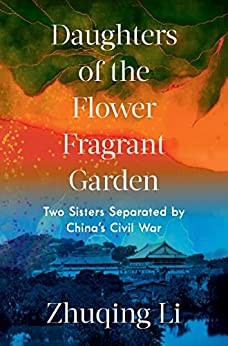
Daughters of the Flower Fragrant Garden: Two Sisters Separated by China's Civil War
by Zhuqing Li
Buy on AmazonShe is, she’s a linguist at Brown University, but this is a memoir. It’s a very personal story informed by a scholarly set of interests. If Fragile Cargo is in part about objects that end up divided between the mainland and Taiwan, this is about a family that is divided. One sister spends most of her life in Taiwan and the other spends most of her life on the mainland. The book also fits with Agents of Subversion , because it’s about this period of disconnection and then reconnection. In this case, it’s not about the US and China reestablishing connection—though that was part of the background—but a story that is true for many families that were divided between China and Taiwan. One of the surprising things about the late 20th century was when members of families that had long been separated began to cross back and forth across the Taiwan Strait. The interconnection between them was a crucial factor in the economic boom of the 1980s and 1990s on the mainland, since investment funds also flowed across the water. That’s not a novelty but it’s worth being reminded of that. It actually gets forgotten in some of the press coverage of tensions between Beijing and Taiwan, that there really are a lot of families with a tie across the Strait. But mostly it’s a very personal story. It’s a memoir and family history, driven by the author’s interest in figuring out the things that the family didn’t talk about. There’s a bit of the historian-as-detective in this book, as she tries to work out what was going on when her aunts were young. It is. Many books about Chinese families in the twentieth century that I find most compelling are the ones where you have a much more complicated idea, by the end, of what a small group of people went through. Too often, we imagine that there were clear winners and losers in the Chinese Revolution. There is a great deal of popularity for the stories where you know clearly which side you’re rooting for and a family is placed mostly or completely on one side. For example, a book that is not as big a deal in the United States, though it is fairly widely read there, but looms incredibly large for UK readers, is Wild Swans . That’s a family story where you have a sense of one throughline. Whereas I think the experience of the Mao period, as well as those just before and just after it, for many Chinese families was much more about ups and downs. Some members of the family were doing better and others worse, based often just on happenstance—where you ended up being. You do get a sense of the individuals in this book. The women in the story are special and they’re not just passive agents. But there is a high degree of luck, which is something that also figures in this. The author herself, in some ways, was lucky. She benefited from having a relative who could help her get connected to the outside world, even though at an earlier point, you would have said, ‘How unfortunate to have a family whose members were disconnected that way.’ That captures something important about China and the China story. Get the weekly Five Books newsletter Looking ahead, I’m already reading a book I’m pretty sure will be on my list next year, Tania Branigan’s Red Memory , which is a book about the Cultural Revolution and how it’s remembered and thought about and forgotten in China. It’s coming out early next year, but I’m reading an advance copy to review. One of the things it does very well, again, is give you this idea that you can’t neatly break up Chinese families or even Chinese individuals into people who were steadily fortunate or steadily unfortunate. Some people are victims at one stage and victimizers at another. That’s part of what makes the 20th century both so tragic and so fascinating in the Chinese case.