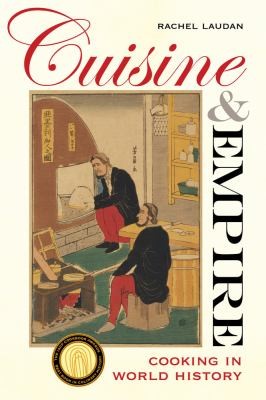
Cuisine and Empire: Cooking in World History
by Rachel Laudan
Buy on AmazonHere the author tells the remarkable story of the rise and fall of the world's great cuisines from the mastery of grain cooking some twenty thousand years ago, to the present. Probing beneath the apparent confusion of dozens of cuisines to reveal the underlying simplicity of the culinary family tree, she shows how periodic seismic shifts in 'culinary philosophy', beliefs about health, the economy, politics, society and the gods, prompted the construction of new cuisines, a handful of which, chosen as the cuisines of empires, came to dominate the globe. This book shows how merchants, missionaries, and the military took cuisines over mountains, oceans, deserts, and across political frontiers.…
Recommended by
"So this is the most recent book I’ve chosen. What Rachel Laudan shows—which most people don’t know—is that what we know about food is mainly about the food of the elite. We don’t know what poor people ate. They probably ate the same thing everyday. Cuisine, as a cultural concept, as a combination of recipes, which she introduces very nicely, has always been dominated by the court or religion. It’s shaped by the elite and then sort of trickles down. The interesting thing about her book is it’s not just a history of why we started eating potatoes, but about how court culture around food changed dramatically. “There’s nobody who can tell you what is right and wrong in food. So all kinds of beliefs can take root” She distinguishes a number of cuisines, from the cereal-based diet of the Middle East, which coincided with the beginning of agriculture and was also linked to the evolution of cities. Then, she moves to the Buddhist cuisine, rice, from central Asia all the way to Japan. There, the concept of refinement is important. The Japanese cuisine that we still know is quite different from Chinese cuisine. Refined taste, delicacies. So the court always goes with the delicate. She also talks about how Catholicism, and the Habsburg and Bourbon courts, have influenced our eating. It’s much more extravagant, these festive meals of 36 different dishes from everywhere. Partly as a reaction to that, the northwestern European Protestant cuisine was much more simple: don’t do too much, don’t exaggerate. What she shows is that we are still influenced by all this today. “We don’t appreciate farmers anymore or people working in the food industry, who make sure that we can all eat, always” Today we actually don’t have court food or imperial cuisines anymore. We are the generation that have what used to be elite food at our disposal in a greater variety, at a lower price, and in unlimited amounts. That’s historically unique. Absolutely. Our brains are hardwired into wanting more food because we come out of hundreds of thousands of years of food scarcity. We want food because you never know whether we’ll go hungry tomorrow. But now, in many big cities all around the world, you can buy food 24 hours a day. It’s about 11%, but these are all in areas of civil unrest and war. It’s those poor people in northern Syria or in the Horn of Africa. 100 years ago, nearly 60% of the world’s population had acute shortages of food. So you see what an enormous difference it is. In the UK and elsewhere, even 50 years ago, people used to spend half of their income on food. It is only 13-14% today, depending a little bit on class. So it is cheap and, therefore, it is also easy to waste. There is this tendency towards stuffing ourselves, literally. If food is really scarce and you don’t have a lot of money, you can’t go on eating food all the time. Yes, of course. Yes, when I take students to the supermarket and ask them what is special there, they never have the right answer. When we see apples in spring, that is not normal. We are far removed from the idea of shortage and the hard labour that went into working, the manual labour day after day. Life was brutish, nasty, and short, and that was it. Farmers 100 years ago, or even 50 years ago, had such difficult lives. I think one of the tragedies of the distance that has grown is that we don’t appreciate farmers anymore or people working in the food industry, who make sure that we can all eat, always. One other thing Rachel remarks on is that having a family dinner is quite a recent middle class thing. Our generation, we still have meals with the family. But you now have a new generation, generation Z, who don’t even have family meals anymore. In the US already, people sit on a couch watching a screen, especially in single parent households. The most telling statistic is that in Europe, the sale of dining tables has declined dramatically. People still have tables, but they do everything on those tables. The table dedicated as a space for food is on the decline. Yes, and this applies to some of the other books I’ve chosen as well. Food is an incredibly fertile lens through which to see history because it ties together things that are so essential to survival. One thing I was just working on in the last few days is cheese. Why does cheddar have the colour it has, do you think? Cheddar has an artificial colour that’s added to the cheese. If you let cows graze, then depending on the season and the quality of the grass, the colour of the milk fluctuates, because the carotenes and other colourings that are in there fluctuate. But the consumer likes to have the summer colour, which is bright yellow. So, starting in the 18th century, an artificial colour that comes from different plants, not from the grass, is added to the cheese-making process. That same colouring is now included in the list of E colourings . These are the E numbers that we have in Europe that are authorised colourings and food additives. There’s a great concern in many countries that these colourings and additives are dangerous for our health. But in the case of cheese colouring and a couple of other examples, they are already centuries old. I tell you this because these kinds of food lenses give you a new perspective on today and on yesterday. That’s a point my book makes again and again. The best way to say this is that farmers don’t grow bread. They grow wheat. Bread is considered a simple food, but the steps that go into making bread are considerable. All food, even the apples you eat—unless you picked them yourself from the tree—pass through some process, some stages of conservation — even if they’re just kept in containers with controlled gas with ethylene so they ripen at exactly the right moment. We do not eat raw food, but I’ll come to that when I talk about Claude Lévi-Strauss."
Food · fivebooks.com