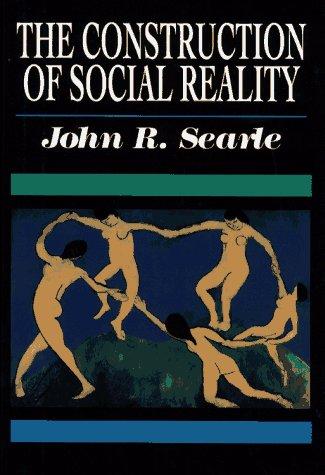
The Construction of Social Reality
by John Searle
Buy on AmazonThis is about how we think about reality. Rather than dive straight in and say, ‘Okay. What does quantum physics say about our understanding of reality?’ I think it really helps to get the ideas organized in your head if you say, ‘what is reality? What do you mean when you talk about reality?’ I think a great place to start is actually one that doesn’t require a laboratory or a laser or a particle collider. You can just sit back in your chair, wherever you are—in your lounge, in your study, in the office, at home—and look around you and play with the idea of what is real. What John Searle does in The Construction of Social Reality is he really brings home—for me at least—the very fragile nature of what we tend to take for granted as reality as human beings living these very complicated lives that we lead. We tend to think of reality as being physical reality—it’s mountains, trees, lakes, streams, animals and other things in our immediate environment that we can perceive directly. Searle says, ‘those are brute, empirical facts about physical reality, but there’s way more to our reality than those brute facts.’ There are also what he calls ‘institutional facts’, stuff that we’ve created to help us live: money being a very, very good example. The five pounds in your wallet, I can guarantee you the paper (now plastic) it’s printed on, and the ink, are not worth five pounds. It only continues to have the value that we believe it to have for as long as we all believe it has a value of five pounds. The status of these things that we’ve created to assist us in living our lives are objects in our social reality. I just thought that was incredibly fun to think about. “Physics is supposed to be the hardest of the hard sciences. You wouldn’t look to physics to find lots of pseudoscientific psychobabble” I was married for the second time in 2012 and I wear a wedding ring. What John Searle would say about a wedding ring is that we use objects in our physical reality—like a piece of metal fashioned into a ring that I wear on my finger—but it’s so much more than a piece of metal. It brings with it a whole set of social obligations to my wife—to remain faithful, to honour and to love, all of those things—entirely created by us. It exists only in our heads, for as long as the institutions remain. And we can see that over the years, they have evolved. That can be a good thing, but it can also be incredibly easily distorted. Once you’ve understood and appreciated that the nature of objects in our social reality are created by humans, you realize how fragile they are and how easily our perception of them can be shifted by what we read, by what we’re bombarded with, the images that we see. This, to a certain extent, explains our current situation with regard to what’s going on in the world. Others have used the way that we perceive things to distort those images and to change our perceptions and understanding of them. One way of thinking about them is to imagine a world where we’ve just disappeared. (In fact, it’s been rather easier to imagine that during the pandemic than perhaps before). All you’re left with are the brute facts: the mountains and the rivers and streams. What’s gone is money. What’s gone is marriage, what’s gone is all of these social structures that we have created in order to live. We blindly assume when we get up in the morning and look at our bank accounts and we reassure ourselves we’ve got enough money to pay the bills for this month. This whole thing is being created by us. It’s been fashioned by our own innate human, mental capacity to create these things and one can have a bit of a debate about the reality of those things as a consequence. Once you’ve got your head around the idea that a lot of social reality only sits up here in your head, then you’ve got a whole other set of philosophical questions to ask about the brute facts, and how we acknowledge the existence of mountains and rivers and trees. It’s not so difficult, then, to swallow what philosophers have been telling us down the centuries—that our entire perception of physical reality is based on electrical signals interpreted by our brain. That’s why my second choice is the screenplay for The Matrix (2001).