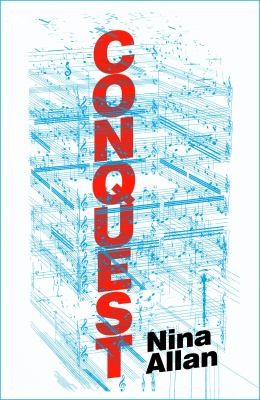
Conquest
by Nina Allan
Buy on AmazonI think Nina Allan is one of the most interesting novelists working in the UK right now, and has been for some time. A lot of her fiction has a self-reflective quality. There’s a collection of short stories of hers, where the stories double back on themselves in all kinds of complicated ways – and when you finished, you’re left thinking, is that a novel? Did all those loose things tie together? Conquest is her most recent novel, and it deals with a lot of cultural baggage. The main characters are obsessed with Bach, they’re fascinated by German Romantic painting. But at the centre of the novel is an obscure 1950s science fiction novel, which may or may not be some kind of documentation of an actual alien invasion. Again, it begins as a mystery, as you mentioned: somebody’s invited to go to Paris, and they promptly disappear. What happened to them? Trying to track them down, again, leads into these unfolding conspiracies, and all of it’s surrounding a mysterious novella – which she then gives us in the middle of the novel. And then you’re asking yourself – is this supposed to be a parody of 1950s science fiction? Is it metafiction? Is it some critical argument about the nature of science fiction? And are we supposed to admire this story? Because it’s not a very good story, actually! But then the characters tell us, no, it’s not a good story. In fact, it may never have been published at all, because nobody can find a copy of it. It gets more and more complicated, and less and less complicated at the same time, which is one of the things I think that Nina Allan does beautifully: the more convoluted the story becomes, the more it begins to coalesce into something that you can see was clearly planned all along. It’s a brilliantly structured novel, I think. I don’t think it’s meant to admire science fiction or to critique it. I think it’s a novel that explores the uses of science fiction: What does science fiction do to its readers? What does science fiction say about the culture? What is the position of science fiction as a mode of imagining, not just as a genre of literature? So to some extent, it’s making fun of the fact that there is a lot of amateur fiction out there – a lot of fiction that’s apocryphal, for example. But it’s also asking the question, what does this kind of imagination do to people? I think that’s a question that comes up again and again in fiction about science fiction: what does it do to us? What does it mean, for its readers? How many people have invested their own fate in what they think science fiction has to tell them? Oh, that’s a good question! There’s probably a fair amount of criticism and scholarship, most recently from Brian Attebery , which deals with the uses of fantasy , and how fantasy has long been a kind of escape valve – going back to the Victorian era, where you had this explosion of fantasy, almost as a counteraction to the explosion of realistic fiction: the Hardys and Dickenses and so on. I’m not sure that science fiction criticism is quite focused on that yet. There is a lot of criticism about the structure and history of science fiction, but it’s not had the same kind of attention that fantasy has had, in terms of the psychological. Yes. One of the arguments I made in Evaporating Genres is that there’s an increasingly blurry line between science fiction and fantasy. There’s an argument going on online right now – in fact, it’s always going on online – about whether Star Wars is science fiction or fantasy. It has some of the appurtenances and things that look like science fiction: it has lightsabers and death rays and spaceships. But the plot is a fantasy story, and the central ‘force’ is a magical force. Increasingly, there are writers who will combine elements of horror and elements of fantasy: there’ll be witches and warlocks in spaceships, there’ll be lesbian vampires in space. But there is still the idea that these are distinct genres with distinct rules and distinct barriers, which some people believe. Some people really want to say, okay, there is the line of the impossible, and you cannot cross it and still be science fiction. You cannot have, for example, vampires and werewolves in a science fiction story. On the other hand, you have people saying, why not? So now you have novels, which mix all of these genres together freely and aren’t concerned at all about genre barriers. … and fantasy became the ‘geography of desire’, which I think I may have borrowed from somebody like H. Rider Haggard. By and large, yes, these are emotions – these are not necessarily literary rules. I think one of the things that science fiction does is bridge the realistic and fantastic. One of the things that made fantasy such a lively genre in the 19th century was that it had hard bitten realism to play off against. Hardy and Dickens and Eliot were writing one kind of fiction – and Eliot, in fact, wrote a flat out attack on fantasy writing in one of her novels, Adam Bede . She says, it’s easy to draw a griffin, with large claws and huge wings, but it’s much more difficult to draw a picture of an ordinary lion. And she had written essays too, probably under a pseudonym, in which she viewed fantasy as a more primitive form of storytelling – going back to the romantics, to Sir Walter Scott, and before that to the Gothic novel. It was a kind of Whig history of fiction: the idea that what had been done now with the Victorian novel is what all literature has aspired to, from the beginning. You could make an argument that science fiction eventually evolved as a blending of the realistic and the fantastic. You can almost see that happening in one of the earliest examples, in Frankenstein . Frankenstein has elements of realism in it. It certainly takes place in real locations, and it has some real science in it, at least according to the beliefs of the time. And yet, it’s a wild Gothic fantasy in another sense. And there’s a debate that’s been going on for decades now, as to whether that’s the first science fiction novel, or simply a Gothic novel that uses a bit of science.