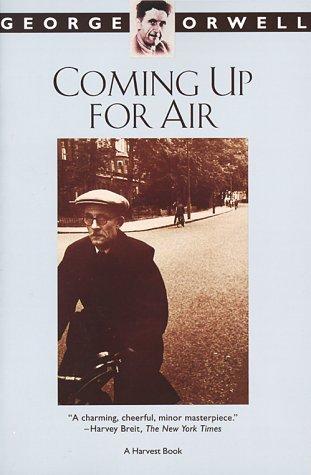
Coming Up for Air
by George Orwell
Buy on AmazonYears in insurance and marriage to the joyless Hilda have been no more than death in life to George Bowling. This and fear of another war take his mind back to the peace of his childhood in a small country town. But his return journey to Lower Binfield brings complete disillusionment.
Recommended by
"Beth: This book was published in June 1939, just before the start of the war. It’s all about the war looming over Britain and its effect on the people. It tells the story of a 45-year-old man called George Bowling. It’s a midlife crisis story. He wakes up one day and gets a new set of false teeth. He’s got kids, a house, and a job, and a wife, and all of them are a bit shit. He starts reflecting on his life and he decides to go back to his home town, Lower Binfield, as he has all these nostalgic memories of Edwardian Britain there, of meadows and fishing and beautiful girls who fancied him and good friends and all the things he feels are missing from his drudgery of a life. I think we all feel that from time to time. So he goes back and of course he finds the same thing he has found in London. Things are different and people have changed. He blames capitalism and progress. His nostalgia is destroyed. The book is about a number of things. All the way through the shadow of the war is looming, as it was when Orwell was writing the book. The crescendo of the book is a bomb dropping in the centre of Lower Binfield: the first bomb of the war. So Bowling’s escape from the reality of conflict and contemporary life is disrupted. It’s all about the loss of that idyllic Britain, and loss of that perfect imagined England. Get the weekly Five Books newsletter It relates to the propaganda and myths used during the Blitz about what we’re fighting for. You’re not going to convince many people to stick around and work for the war effort if what you’re fighting for is a sludgy, wet trudge up the hill to your job and paying your gas bill. You have to fight for this Edwardian England, the freedom and peacetime and the rolling green hills that were used in the propaganda at the time. They used images of pastoral scenes, things only a very small number of people in Britain could claim as their own. George Bowling is going back to Lower Binfield to re-experience the Britain he loved, but his conclusion is there is no escape from war. The book didn’t do well. It was published in the June of that year, and Orwell said it was killed by the outbreak of war, and then “blitzed out of existence.” The fact it wasn’t toeing the propaganda line meant it wasn’t really a big seller. It’s a shame. But it’s incredible as a premonition of what would go on, the kinds of romanticism and nostalgia about Britain that were instrumentalised for the war to create this myth of Britain. Beth: Again it’s that story-truth that keeps you going. When we asked Grandad what it was like during the Blitz, he just said everyone was tired all the time. That was his main memory: not the trauma, the agony, and the fear; just the exhaustion. People were working 18, 19 hour days. They were getting up, doing their jobs, then going home and volunteering, or staying up all night in an Air-raid shelter. The reality of life during that time was so far away from these romantic visions. But I think they were incredibly important in providing this kind of reverie, this group dream of what they were protecting. Thom: A writer called Joseph Campbell wrote about mythology, he talks about the idea that, just as an individual has dreams that are about interpreting the day, society has a group dream that represents its attempt to understand things. In a way, that’s what Coming Up for Air is about: the mythology George’s character calls on for this reassurance, his hope in the face of this apocalyptic thing that’s about to happen, when everything will be disrupted and changed. The whole of society was doing the same with propaganda, and Orwell’s book is a critique of that image. Beth: That’s why his book didn’t sell, it was a critique of the things people were doing to try and get through the situation."
Myths of War · fivebooks.com