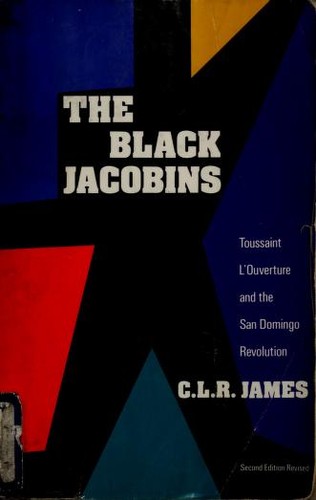
The Black Jacobins
by C.L.R James · 1938
Buy on AmazonEn 1789, les deux tiers du commerce extérieur de la France se faisaient avec sa colonie antillaise de Saint-Domingue, laquelle représentait le plus grand marché de la traite européenne des esclaves. La plus grosse colonie du monde, fierté de la France et objet de convoitise de toutes les autres nations impérialistes, faisait partie intégrante de la vie économique d'alors. Tout cet ensemble reposait sur le labeur d'un demi-million d'esclaves. Au mois d'août 1791, après deux ans de Révolution française avec ses répercussions à Saint-Domingue, les esclaves entrèrent en révolte. Leur lutte dura douze ans.…
Recommended by
"Read some C.L.R. James — the best of the Marxist analysis is indispensable but inadequate in the end."
Books from India & Global Left: Cornel West on Freedom, Justice, Democracy and Faith · youtube.com
"That’s right at the top of my list because many Haiti-watchers see it as the best account of the Haitian revolution of 1791-1803. It focuses a lot on Toussaint Louverture as the key leader in the revolution. His life and his leadership are as much a topic as the revolution itself. Toussaint is credited with uniting the revolutionary forces against the French presence. I think it is a must-read for anyone involved with Haiti at a political level. It is also useful to anyone else involved in the country. The book really highlights the incredible achievement of the Haitian nation, namely to be the only ever slave revolution leading to shaking off slavery and achieving independence by armed struggle. I think that much of Haiti’s current political socio-economic problems can only be understood in the light of French slavery and the way in which it was brought to an end by the slaves of Haiti. Well, you had the small mulatto élite who were the result of colonialism – being in the ideal position to lead when the French were thrown out or killed by Dessalines. So, early on, a split occurred where you had a southern mulatto republic led by the wealthy Alexandre Pétion and the northern kingdom led by black Henri Christophe. And after that split was overcome the mulattos dominated, thanks to their French education, and unfortunately established a regime which wasn’t that different to the one the French had before—though slavery was, of course, formally abolished. Mulatto domination endured to the days of Papa Doc and this tragic split was the result of slavery. The mulattos’ aim in the revolution was to continue their lifestyle, because they also had slaves and were beneficiaries of the slavery system. All this is looked at in fascinating detail in the book. You also have to remember that James wrote the book just as the Nazis were at the height of their power and there is quite a bit of understandable emotion involved, so one must read some of the passages in the book in the light of James’s strong communist leanings."
Haiti · fivebooks.com
"This is a very important book for me, about the first and only successful slave revolt in the Americas, which happened in Haiti. C L R James’s book is very complex because it does not make the rebellion’s leader, Toussaint L’Ouverture, into the sort of plaster saint that people now might make of Martin Luther King or, dare one say, Nelson Mandela . This is the guy who led a revolt against an absolutely brutal, manipulative slave-owning class and in some respects he had to be just as ghastly. Indeed some of his lieutenants were even worse – to some extent you can see the seeds of what has become modern day Haiti in the nature of the revolt. But nonetheless, we have this incredibly heroic figure battling two things. First, the Napoleonic empire, this vast, colossal military and colonial power. And this bloke says, ‘OK we’ve had enough of this.’ Toussaint was a natural compromiser – there is an academic interest now in Barack Obama as a natural compromiser and a leader. Well, Toussaint tried again and again during this rather short revolt to make a deal with the French. But time and again either they reneged or they tried to double-cross or they couldn’t hold their side of the bargain. But the second part of the book is really more significant for what I do, namely the problem of how you overcome a systemic discrimination. In order to make the plantations work you had to separate the slave labour from the rest of humanity, categorise it and control it to make it work. One of the most telling things in the book is that James describes the way in which the plantation owners would categorise the slaves according to how much European blood they had: there were 128 different classifications. It was an example of how the society in Haiti was so rigidly constructed to maintain slavery. And the Haitian revolutionaries had, somehow, to deal with overcoming and dismantling this incredibly rooted system. This is what people today might describe as institutionalised racism. Get the weekly Five Books newsletter What interests me is the difficulty of tackling a way of thinking and doing things that is built into society. It is actually much more obvious and evident today in relation to gender. The way we do things automatically stacks the cards against anybody who doesn’t work five days a week, nine to five, for 40 years continuously, and overcoming that is probably the single biggest barrier to equality we have to tackle."
Equality · fivebooks.com
Patrick Collison's Bookshelf · patrickcollison.com