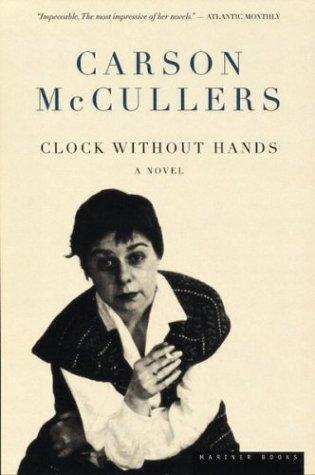
Clock Without Hands
by Carson McCullers
Buy on AmazonSet in Georgia on the eve of court-ordered integration, Clock Without Hands contains McCullers's most poignant statement on race, class, and justice. A small-town druggist dying of leukemia calls himself and his community to account in this tale of change and changelessness, of death and the death-in-life that is hate. It is a tale, as McCullers herself wrote, of "response and responsibility--of man toward his own livingness."
Recommended by
"This is by Carson McCullers, an American author. It’s a complex novel from 1953 and I chose it partly for the same reason as I chose Frankenstein, which is that in great literature we see, in graphic and amplified detail, things that go unnoticed otherwise. Every idea that we have spoken about is magnificently displayed in this book. The first line of the book captures it all: “Death is always the same, but each man dies in his own way.” In the next line, we are introduced to the main character, TJ Malone, who, at age 40, is about to be diagnosed with leukemia. This is long before Elizabeth Kübler-Ross wrote about the five stages of grief — denial, anger, bargaining, depression and acceptance. But that’s what happens in the book. Malone is told he has leukemia, his first reaction is that the doctors have got to be wrong. Then, just like in our studies, he starts hating people who are different and he becomes reflexively repulsed by his own body. As we go through the book, he is estranged from his wife, who he is still married to but claims to not have loved for decades. Just like Frankenstein, who is so preoccupied with denying death that he doesn’t notice the people around him and can’t appreciate nature, you see how this guy, who at the beginning of the book has planted a garden, doesn’t pay attention to it all summer. Then, at the end of the summer, he walks out and there are these beautiful vegetables. She talks about how ‘livingness’ is so miraculous and all around us — and because it’s all around us, we don’t notice it. Maybe this is not at all subtle, but the point is that life goes on. Get the weekly Five Books newsletter Right in the middle of the novel, Malone checks into the hospital and they have an ambulatory library. He grabs a Kierkegaard book and he says he doesn’t understand a single sentence in it. Kierkegaard has a saying, that the greatest danger, that of losing oneself, may pass off quietly as if it were nothing. Every other loss — that of an arm, a leg, $5, a wife etc. is sure to be noticed. This is where Malone realizes that he’s about to die, but he has not yet lived. It’s the turning point of the book. He realizes that he loves his wife and that she loves him. At the beginning of the book, the idea of clock without hands is the ultimate depiction of the terror of death, because you realize that the meter is running, and you can expire at any time. By the end of the book — and the phrase only appears twice in the book — it’s a reflection of the fact he now accepts that, and the fact that he’s about to expire momentarily no longer matters. In the classes I teach, I like this book as an uplifting and palliative culmination of the study of the other books — which to young people can often be brutally traumatic. When they evaluate the class at the end of term students often say things like ‘Thank you and f**k you! You made me read all these books and they’re great, but now what do I do?’ This book is a nice way to end on a high note, but a realistic one. He does die, as will we, but surrounded by loved ones. At the risk of sounding like Walt Disney, love does conquer death, not literally, but at least psychologically."
Fear of Death · fivebooks.com