← All books
The City and the Stars
by Arthur C. Clarke
Buy on Amazon
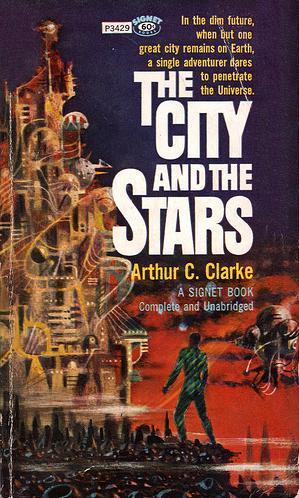
This is the absolutely key text, the one where Clarke most describes his beliefs about the future and about society. It’s utopian fiction, and for Clarke this is the book he’s most emotionally invested in. He starts writing this in 1935, when he’s about 17. His 1948 novella Against the Fall of Night is an early version of this novel. He then takes another eight years and finally produces the full-length novel in 1956. So he’s basically working on this book for about 21 years – at which point he’s still a relatively young guy, of course, at 38. It’s a deep, far future novel – something like Jack Vance’s The Dying Earth from 1950. We have a highly technological automated society, Diaspar, which is run by a central computer – a benevolent, benign central computer. This is 1956, and the technology of cybernetics has begun to percolate, with the early works of Norbert Wiener and people like that. It’s the last refuge of humanity. There are no new children, but the inhabitants of Diaspar lead a prolonged existence. When they die, they get fed back into this bio-bank, from which the next generation will emerge – but it’s the next generation of themselves. Nobody new is born ever in Diaspar. Except that we have ‘the one’: we have a hero, Alvin, who we discover has never lived before. And of course, we know in these narratives, he’s going to have a destiny. He is an interesting character, Alvin. He’s bored and fed up in his utterly perfect society where nobody has to work. Again, work is important: in The Sands of Mars they work terraforming the planet; here, nobody works. They are hedonistic lotus eaters, they play virtual reality games, and nobody does anything. Alvin is yearning for quests and adventure. He allegedly has a romantic liaison, but doesn’t seem very much interested in the girls, which is interesting. To cut a long story short, he discovers another city – Lys – or, rather, not a city, it’s agricultural. Another utopia, where technology doesn’t exist. They do procreate, they do have children. I can’t give more spoilers away to you, but he discovers that all of this is part of a much, much larger cosmic narrative, and ultimately about humanity’s place in the universe. On the one hand, we have this idea that humanity does have a role to play in the universe; but we also find that it’s marginal, that we’re a much, much smaller thread in the whole tapestry of this cosmic history. And that I think tells us a lot about Clarke. Yes, he wants to have this expansive view of the cosmos; but his view of humanity is, yeah, we’ve got a part to play, but it’s actually really small. There’s a kind of humility about Clarke – his nickname was ‘Ego’, but when you look at his writing, there’s often this lack of ego. We’re important, but we’re not that important. There’s another way to look at The City and The Stars – it’s the mid-50s, the period of decolonization. With Diaspar, there was an imperial history behind the city, and it’s all faded away. Not unlike Britain, of course, at this time. So this is saying – we’re going to find a new place in the universe, but it’s going to be smaller than it was before. But that’s good, too – because it means we are knotted into this whole great, larger thread of history. It’s interesting, on the new wave thing – bear in mind that when Clarke won the Nebula Award for Rendezvous with Rama , he actually beat Thomas Pynchon’s Gravity’s Rainbow . An interesting moment, which Jonathan Lethem has written about in his contentious essay, ‘ The Squandered Promise of Science Fiction ’. We wanted to go back into the mysteries of Clarke with this book. He isn’t as straightforward a figure as you might think he is. And even though he’s one of those default voices in genre science fiction, he isn’t written about as much as you would have thought. So we wanted to go back to the writing and see it perhaps slightly differently – uncover aspects of the writing that haven’t been explored before. A ‘rendezvous’ is about meeting with an assignation in mind – but we don’t really know what Clarke’s assignation was, because he was this enigmatic figure. So this is all about trying to find some hidden assignations in Clarke’s work. In Clarke’s novel Rendezvous with Rama , there’s this weird object that moves into our solar system, and nobody knows what it is: it’s the classic Big Dumb Object in science fiction. The progress of this craft causes huge panics and financial crises on planet Earth. And we have our plucky group of engineers, scientist types again, who are going to find out what it is. And then Rama, as it’s called, just wanders out of the system and goes back into bleak space! And that’s the interesting thing about it – on the one hand it’s another cosmic engineer story, about how we explore this thing, and what we find out. But it’s also about what we don’t find out – and there’s really not much plot. This thing comes in, and it disappears again, and we know very little about it. It’s almost similar to New Wave science fiction, because it’s shrouded by everything that we don’t know. When we think about the kind of experiment with science fiction that occurs in New Worlds under Michael Moorcock’s editorship, we think of something radically plotless, like Ballard’s Atrocity Exhibition ; but actually Rendezvous with Rama is very plotless, and chimes with that later New Wave moment. Clarke may want to trust the science, but he is aware that science doesn’t know everything, and that things are inexplicable.
Recommended by
"This is the absolutely key text, the one where Clarke most describes his beliefs about the future and about society. It’s utopian fiction, and for Clarke this is the book he’s most emotionally invested in. He starts writing this in 1935, when he’s about 17. His 1948 novella Against the Fall of Night is an early version of this novel. He then takes another eight years and finally produces the full-length novel in 1956. So he’s basically working on this book for about 21 years – at which point he’s still a relatively young guy, of course, at 38. It’s a deep, far future novel – something like Jack Vance’s The Dying Earth from 1950. We have a highly technological automated society, Diaspar, which is run by a central computer – a benevolent, benign central computer. This is 1956, and the technology of cybernetics has begun to percolate, with the early works of Norbert Wiener and people like that. It’s the last refuge of humanity. There are no new children, but the inhabitants of Diaspar lead a prolonged existence. When they die, they get fed back into this bio-bank, from which the next generation will emerge – but it’s the next generation of themselves. Nobody new is born ever in Diaspar. Except that we have ‘the one’: we have a hero, Alvin, who we discover has never lived before. And of course, we know in these narratives, he’s going to have a destiny. He is an interesting character, Alvin. He’s bored and fed up in his utterly perfect society where nobody has to work. Again, work is important: in The Sands of Mars they work terraforming the planet; here, nobody works. They are hedonistic lotus eaters, they play virtual reality games, and nobody does anything. Alvin is yearning for quests and adventure. He allegedly has a romantic liaison, but doesn’t seem very much interested in the girls, which is interesting. To cut a long story short, he discovers another city – Lys – or, rather, not a city, it’s agricultural. Another utopia, where technology doesn’t exist. They do procreate, they do have children. I can’t give more spoilers away to you, but he discovers that all of this is part of a much, much larger cosmic narrative, and ultimately about humanity’s place in the universe. On the one hand, we have this idea that humanity does have a role to play in the universe; but we also find that it’s marginal, that we’re a much, much smaller thread in the whole tapestry of this cosmic history. And that I think tells us a lot about Clarke. Yes, he wants to have this expansive view of the cosmos; but his view of humanity is, yeah, we’ve got a part to play, but it’s actually really small. There’s a kind of humility about Clarke – his nickname was ‘Ego’, but when you look at his writing, there’s often this lack of ego. We’re important, but we’re not that important. There’s another way to look at The City and The Stars – it’s the mid-50s, the period of decolonization. With Diaspar, there was an imperial history behind the city, and it’s all faded away. Not unlike Britain, of course, at this time. So this is saying – we’re going to find a new place in the universe, but it’s going to be smaller than it was before. But that’s good, too – because it means we are knotted into this whole great, larger thread of history. It’s interesting, on the new wave thing – bear in mind that when Clarke won the Nebula Award for Rendezvous with Rama , he actually beat Thomas Pynchon’s Gravity’s Rainbow . An interesting moment, which Jonathan Lethem has written about in his contentious essay, ‘ The Squandered Promise of Science Fiction ’. We wanted to go back into the mysteries of Clarke with this book. He isn’t as straightforward a figure as you might think he is. And even though he’s one of those default voices in genre science fiction, he isn’t written about as much as you would have thought. So we wanted to go back to the writing and see it perhaps slightly differently – uncover aspects of the writing that haven’t been explored before. A ‘rendezvous’ is about meeting with an assignation in mind – but we don’t really know what Clarke’s assignation was, because he was this enigmatic figure. So this is all about trying to find some hidden assignations in Clarke’s work. In Clarke’s novel Rendezvous with Rama , there’s this weird object that moves into our solar system, and nobody knows what it is: it’s the classic Big Dumb Object in science fiction. The progress of this craft causes huge panics and financial crises on planet Earth. And we have our plucky group of engineers, scientist types again, who are going to find out what it is. And then Rama, as it’s called, just wanders out of the system and goes back into bleak space! And that’s the interesting thing about it – on the one hand it’s another cosmic engineer story, about how we explore this thing, and what we find out. But it’s also about what we don’t find out – and there’s really not much plot. This thing comes in, and it disappears again, and we know very little about it. It’s almost similar to New Wave science fiction, because it’s shrouded by everything that we don’t know. When we think about the kind of experiment with science fiction that occurs in New Worlds under Michael Moorcock’s editorship, we think of something radically plotless, like Ballard’s Atrocity Exhibition ; but actually Rendezvous with Rama is very plotless, and chimes with that later New Wave moment. Clarke may want to trust the science, but he is aware that science doesn’t know everything, and that things are inexplicable."
"The City and the Stars is a book which is about trying to reconcile two different communities which serve as a metaphor for two different worlds. The way the reconciliation happens is through creating crisis, and trying to search beyond one’s own experiences and world view in order to create a better future out of that crisis. The protagonist is a creative and lonely individual who is forced to rebel against the indoctrinated way in which his society has been living. He is able to envisage the world beyond his community which no one else has had the courage to see. He discovers another ‘world’ and tries to reconcile the two disparate communities. In doing so, this provokes a crisis, from which he can then say that there is a need for both of us to work together in order to create a better world. That’s exactly why The City and the Stars inspires me about disaster diplomacy. Disaster diplomacy is about examining two different worlds that rarely interact, except in crisis mode. In reality, we know enough about each world, and have the resources, to be able to limit disasters, but some groups in society are choosing not to do so. Disasters are created by society – the many choices made by governments and others, particularly in terms of resource allocation. Disaster diplomacy is about trying to bring two worlds together and use crisis points (or even the idea of a crisis), to make things better. Diplomacy is supposed to be about peace, although I realise that this isn’t always the case in practice, and that’s ultimately what we are aiming for."