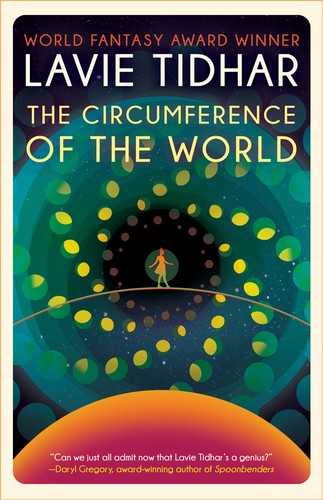
The Circumference of the World
by Lavie Tidhar
Buy on AmazonTidhar is an Israeli-born writer, who’s very open about his experience as a science fiction fan from childhood: his experience growing up in a kibbutz, and his experiences in the literary communities of London, where he lives now. So all this informs his fiction, which has always cheerfully alluded to earlier traditions of science fiction. He has an eclectic collection of stories called Central Station , which are set around a giant future Spaceport in Tel Aviv, and there are figures in it who take their names from earlier novels and stories by well-known science fiction writers. There’s a sort of vampire-like figure called Shambleau, a name borrowed from a pulp story by C. L. Moore back in the 1930s. These allusions were easter eggs for science fiction readers; they weren’t critical to the plots of these stories. When we get to The Circumference of the World , though, he’s really writing a novel that’s partly about a fictional science fiction novel, but largely about the whole culture of science fiction; and he takes it on in a more direct way than he has before, using real names, real characters. The only thing he backs away from a little bit, probably for all kinds of legal reasons, is that there’s clearly a Scientology cult involved, and the figure is clearly based on L. Ron Hubbard, but he’s not called that! Other characters – John W. Campbell, Isaac Asimov, for example – show up in the novel itself, sometimes as correspondents with somebody else, sometimes there are documents within the story. Tidhar’s clearly familiar with that period of science fiction history – which has been, I should mention, very well documented by Alec Nevala-Lee in a book called Astounding , which is a kind of joint biography of John W. Campbell, Isaac Asimov, Robert A. Heinlein, and L. Ron Hubbard, all of whom interacted in interesting, different ways. One of the things that comes across in Tidhar’s novel is the contradiction between science fiction’s attraction to hyper-rationalistic ideas of the future on the one hand, and completely off the wall insane ideas involving psychic powers and alien civilizations and so forth on the other. It comes across in this novel, as well as in Alec Nevala-Lee’s book, that Campbell – who was probably the most influential editor in the history of science fiction magazines – was on the one hand, very insistent that writers like Asimov and Heinlein adhere to what is known science and what is possible with technology; but on the other hand, very fond of writers like A. E. Van Vogt and L. Ron Hubbard, who wrote completely crazy fantasies of power, mind control and telepathy. Campbell himself was fascinated with ideas of telepathy and mental powers, what they called psi powers. So that kind of contradiction is one of the things at work in The Circumference of The World . As for the plot: a brilliant mathematician remembers an obscure 1962 science fiction novel she read as a child, and her boyfriend disappears trying to track down a copy. And the investigation leads, like any good private eye investigation, to layer upon layer of further mysteries and further puzzles, involving everything from Russian mobsters to real-life pub meetings of London science fiction writers. As an investigative mystery, I think it’s pretty successful in its own right. And it can be read by somebody who, again, has very little or no interest in science fiction. In fact, I’m not sure I would even call The Circumference of the World a science fiction story, except for the question of whether some of the science fiction in the stories within stories might turn out to be real. When I read this and reviewed it, I thought other science fiction readers – people who at least know something of the history of science fiction – were going to think it was a hoot. It’s going to be one in-joke after another. But one question is, how well does he succeed in making these characters real for people who don’t know who they are? To what extent is the whole novel appealing only to the science fiction fans? My sense is that his sketches of these characters are strong enough to make them understandable as peripheral characters to the central story; and the central story I think, has its own power. There’s definitely a conversation going on. And one of the things that’s fascinating to me is that there are clearly science fiction stories by people outside the genre, who are fascinated by it; and some of them are in dialogue, some of them are not. For example, Margaret Atwood was very clear when The Handmaid’s Tale first came out that this was not to be thought of as science fiction, or to be thought of as in dialogue with science fiction, even though it really was. At the opposite end of the spectrum was Doris Lessing, who when she began writing science fiction knew perfectly well what she was doing. She had grown up reading a fair amount of science fiction, and her Canopus in Argos and all those things were meant to be in dialogue with earlier science fiction. She was friends with people like Brian Aldiss, she had read writers like Olaf Stapledon. So for mainstream writers, the choice is there: whether to make this novel or story in dialogue with science fiction, and writers within the genre, or to ignore the history of the genre – but they’re going to get compared to it anyway. They’re more or less trapped in the dialogue. Let’s take the idea of a generation spaceship, which is one of the undying clichés of science fiction—a spaceship journey so long that it takes generations to complete, with an entire society evolving onboard. You can’t write a generation spaceship story now without some readers comparing it to 20 other stories in the past. On the other hand, you can take the old idea and repurpose it to explore a variety of new issues, from income or gender inequality to colonialism. No, I suppose science fiction isn’t the only genre that writes about itself. I’ve read a handful of murder mysteries that are about mystery writers, for example. And I strongly suspect there are a number of romance novels about romance novel writers. There clearly is a tradition of horror stories about other horror stories, with figures like Poe and Lovecraft showing up as characters on a fairly regular basis. And for that matter, think of how many literary novels are about novelists! So I don’t think this self-recursiveness is something that’s invented by or confined to science fiction. But science fiction writers and readers seem to view it as a way of both celebrating and validating the genre’s past. A reader who understands the allusion can feel a part of a community of similar-minded readers, or at least feel that they are in on the joke. But if the novel succeeds on its own terms, none of that should be essential to enjoying it.