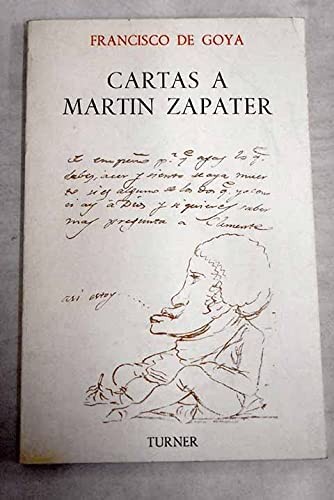
Cartas a Martín Zapater
by Mercedes Águeda & Xavier de Salas
Buy on AmazonI’ve asked myself if it would have been possible to write a biography of Goya without the letters he wrote to his dear friend, Martín Zapater, in Zaragoza. I don’t know that I would have undertaken it without the insights they offer into Goya’s character. A bit of background: selections from the letters were used by Zapater’s grand-nephew as a source for an 1868 biography of the artist; they have long been known, but remained unpublished until the 1982 edition by Xavier de Salas and Mercedes Águeda. This was a watershed, which lead to a great deal of new research on the many people mentioned by Goya; in the 1990s two English translations (one edited by Sarah Symmons , with translations by Philip Troutman; the other by Jaqueline Hara) were published. In 2003, Águeda published a revised edition with extensive notes and some redacting, incorporating the research to date. The Museo del Prado continued to collect the letters and now owns about 119 of the 140+ letters known, all reproduced with commentary on the Goya en el Prado website. As with the ‘Italian Notebook’ seeing the letters reproduced—with cross-outs, silly squiggles as Goya reprimands Zapater for not writing, and drawings—brings us closer to the artist. The relationship between these two men—the artist, convinced of his calling and genius, and the businessman and dedicated public servant—evolves as we read the correspondence, which begins following Goya’s move with his family to Madrid in 1775. During the first five years, much of the conversation revolves around common acquaintances from Zaragoza, including Goya’s brother-in-law, the court painter Francisco Bayeu. Goya also shares good news, such as the approval he received when he presented a group of tapestry cartoons to the king and crown prince and princess. He sends Zapater sketches for his tapestry cartoons (and is annoyed when the chief court architect takes sketches he was reserving for his friend), as well as his etchings after Velázquez. When in 1780 Goya plans his return to Zaragoza to paint with his in-laws in the Basilica of El Pilar, Zapater helps with arrangements. “After 1789, the tone changes. Now court painter, Goya is more introspective about his position” Goya’s joy in again seeing Zapater during that visit is cut short when he is dismissed from the project. In Goya’s eyes, the fault lies entirely with Francisco Bayeu, who had in fact been quite helpful to Goya during his early years at court. Goya returns to Madrid, determined to make his way without Bayeu, and reports every step of the way to Zapater, while also conveying his frustrations and worries over his finances. So the letters from the 1780s are crucial to understanding Goya’s career, as he reports his progress in impressing influential people (most importantly, the Count of Floridablanca and the king’s brother, Don Luis) and commissions received. We trace the turn in his fortunes, as he reconciles with Bayeu, who in 1786 arranged for Goya to receive a salaried position as painter to the king. Goya’s humour returns, he is thankful for all he has received—even before becoming court painter four months after the accession of Carlos IV. While the correspondence of this decade offers insight into Goya’s care for his mother and siblings following his father’s death in 1781, much is never said (or perhaps was said in letters lost). We hear of Goya’s wife, Josefa Bayeu, only when she has given birth or miscarried, or is working on a dress for Zapater’s aunt, and there is no mention of the deaths of six of Goya’s children, possibly victims of the smallpox epidemic of the early 1780s. After 1789, the tone changes. Now court painter, Goya is more introspective about his position, and aware of jealousies at court that threaten his standing with the king. He returns to Zaragoza in 1790 and 1791 to visit Zapater and letters that follow those visits betray Goya’s intense feelings toward his friend, which some have interpreted as an indication of a physical relationship between the two men. I don’t find evidence for this, but to be sure Goya felt a deep love for Zapater. To me, his letters suggest that Zapater did not reciprocate—a question that might be resolved were Zapater’s letters to come to light!