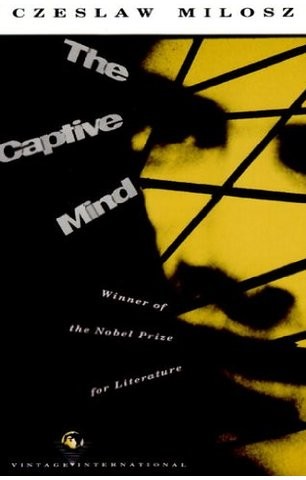
The Captive Mind
by Czeslaw Milosz
Buy on AmazonThe best known prose work by the winner of the 1980 Nobel Prize for Literature examines the moral and intellectual conflicts faced by men and women living under totalitarianism of the left or right.
Recommended by
"The Captive Mind isn’t a straight memoir. Although Milosz is writing about his own life and his past, he is also grappling with a larger subject: How his generation of liberal intellectuals came to collaborate with, and work alongside, the Communist party. And he is trying to understand his own behaviour: Why did I act that way? To explain, he uses an extended metaphor: “It’s as if we all took a magic pill, became temporarily enchanted and went along with this ridiculous thing.” Then he goes through some “case studies” of individuals’ behaviour – even though they’re not named in the book, we know who he was writing about – and tries to explain why people collaborated or opposed the regime. In essence, the book is about the mentality of collaboration with communism. He gives a lot of reasons. He explains the shattering effect of the war in that part of the world, where the fighting was far more brutal than anything in Western Europe. Between 1939 and 1945, it was normal, in Warsaw, to see a corpse lying in the street. Moral norms were shattered, as all sorts of illegal activity became normal too. Good people robbed banks and planted bombs, on behalf of the Underground. After the war, many people felt they couldn’t just go back to the way things were before. They couldn’t just reconstruct 1920s or 1930s Poland, many felt: everything has been changed by this war and we need to start from scratch. Miłosz also talks about people who wanted their books published or their careers advance, people who collaborated in order to get ahead and join the new literary establishment. He is important to read because he’s simultaneously critical of his characters and sympathetic to them. It’s very difficult, now, to think back into that time, when people had very limited choices. If you chose to oppose the regime, that might mean you couldn’t get medicine for your sick mother, your children couldn’t go to school and you might get kicked out of your apartment. We don’t have to face those choices. Miłosz is very good at explaining them."
Memoirs of Communism · fivebooks.com
"Yes. Milosz tried to explain – as the title suggests – how thinking people could accept communism from inside the communist system. How does one not resist or just endure, but actually place one’s mind in the system? He points to a number of ways in which the mind can adapt. You can accept one larger truth that guides your interpretation of all of the smaller untruths, accept a vision of the future that is so bright that it drives away the shadows of the various dark acts of your own time and place. Or you can collaborate on the outside but preserve an inner core of yourself that does not collaborate on the inside. Milosz’s point was that all of these things are possible as human adaptations to a situation, but impossible as ways of preserving humanity. In fact they’re nothing more than stories people tell about themselves, as they give in to a system which is actually inferior and repressive. It’s an interesting argument because it gives people an alibi, which is what Milosz’s publisher in Paris – Jerzy Giedroyc, also a very important Polish intellectual – recognised. He felt that this was all bunk – that people collaborated because they were scared and needed money, and that what Milosz was arguing was just superstructural nonsense. But he published it anyway, because he wanted people who did collaborate and made their way out of communism to have a story to tell about themselves. That debate, about whether these mechanisms were authentically felt or not, continues to this day. I find it interesting that people in Poland and undergraduates around the world stake out the positions both that there was something authentic about the internalisation of collaboration, and that it really was just a straightforward calculation of one’s best interests."
Dissent · fivebooks.com