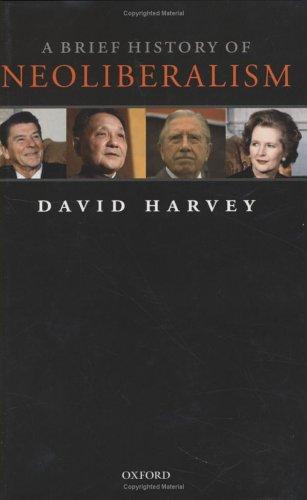
A Brief History of Neoliberalism
by David Harvey
Buy on AmazonFirst published in 2005, Harvey’s book probably remains the best short history of neoliberalism. It defines neoliberalism as an ideology that seeks to unleash capitalist dynamism, and to improve the conditions of capitalist accumulation along the lines that I just suggested. Harvey argues that neoliberalism emerged in the 1970s during a crisis of ‘capital accumulation,’ or ‘capital disaccumulation’. This was a moment when capitalists were not able to amass capital on the desired scale, or make the kind of profits to which they had become accustomed. The postwar economic miracle of Europe and the postwar expansion in the United States were slowing down; stagflation, shrinking profit margins, and declining productivity rates were symptoms of economies in decline. In this moment of economic stress, capitalists began to question the compromises that they had previously struck with workers to redistribute a portion of their wealth downward through the social order. They now viewed such redistributionist policies as a drag on profits and on capital accumulation. They sought to release themselves from those fetters and to reinvigorate capitalism once again. Harvey is very good at discussing the response of capitalists to the crisis of the 1970s. Harvey views neoliberalism as an elite project, as a strategy by and for capitalists to reclaim lost power and to reject older arrangements governed by the principles of class compromise. He sees this project as having made its greatest progress in the United States and Great Britain, epitomised by the rise of Ronald Reagan and Margaret Thatcher . Even though he recognises neoliberalism as an elite project, Harvey understands that it had popular appeal among masses of ordinary people in Britain and America. How did an elite project of that sort persuade voters in democratic societies to go along with it? Harvey’s answer is not entirely satisfying, but simply posing this important question is one of his book’s achievements. Too many scholars writing about neoliberalism simply presuppose that elites were able to impose their views on the masses either through a brute exercise of their power or through ideological deception—selling the voters a bill of goods, filling their minds with ‘false consciousness’. The Koch brothers are an interesting and illustrative case in this respect. They are among the richest capitalist families in the United States. They are passionate advocates for removing the state from all the ways in which it might impede capitalist accumulation and development. They are deeply involved in politics and support all kinds of political groups aligned with their ends. They often act furtively so as to make it seem as though the political groups that they are funding are grassroots movements operating independently and from the bottom up. The Koch brothers do act furtively; they do deceive. But treating mass support for the positions they espouse as a phenomenon generated entirely by elite manipulation is problematic. The question of consent—how ordinary people voluntarily give their assent to an elite project—is a critical one. It is a question that we must satisfactorily answer—and that my new book on the neoliberal order attempts to answer—if we are to understand the enduring power and mass appeal of neoliberal beliefs. Harvey’s history is also a global history. He understands that neoliberalism aspires to be a global project and requires a set of international institutions, including the International Monetary Fund, the World Bank, and the World Trade Organization, to make that aspiration real. He analyzes the Washington Consensus—a set of policies developed in the Global North to impose neoliberal economic principles on the Global South. He also pays quite a lot of attention to China’s reorientation away from communism and toward capitalism, a tendency that accelerated dramatically in the wake of the Soviet Union’s early 1990s disintegration. The collapse of communism allowed capitalism—and neoliberal principles—to go global in the 1990s in a way that had not been possible during the decades of Soviet influence and power.