← All books
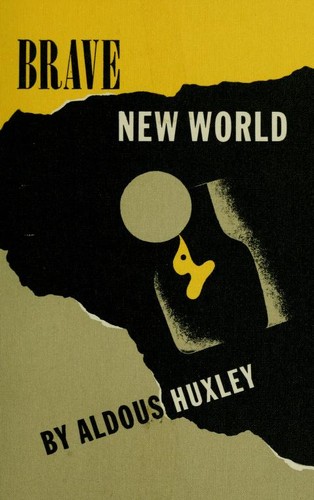
Brave New World
by Aldous Huxley · 1932
Buy on Amazon
Originally published in 1932, this outstanding work of literature is more crucial and relevant today than ever before. Cloning, feel-good drugs, antiaging programs, and total social control through politics, programming, and media -- has Aldous Huxley accurately predicted our future? With a storyteller's genius, he weaves these ethical controversies in a compelling narrative that dawns in the year 632 AF (After Ford, the deity). When Lenina and Bernard visit a savage reservation, we experience how Utopia can destroy humanity. A powerful work of speculative fiction that has enthralled and terrified readers for generations, Brave New World is both a warning to be heeded and thought-provoking yet satisfying entertainment. - Container.
Recommended by
"The most prophetic book of the 20th century. If you have time for just one book, this would be my top choice."
A Haphazard Guided Tour of Humanity on the Brink ·
ynharari.com
"This dystopian classic explores societal control through technology and conditioning, aligning with Lex Fridman's interest in artificial intelligence's ethical and philosophical implications. It's an expected read for someone exploring the future of humanity and technology."
"Brave New World is the oldest book and the first in this list I read, when I was at school. I revisited it again recently. I’ve always loved science fiction, or speculative fiction , or whatever we want to call it. I love stories that take an idea of what the world could be and help us understand our own world better. I remember reading Brave New World and being transported by it. It was recognisable enough in its depictions of the world to make you understand what it was playing on. Yet also to realise how long ago it had been written. “He describes a physical world that is seductive—yet carries multiple risks with it” It shows the ways in which technology , our need for certain creature comforts and consumer culture can be used to manipulate us. That our need for pleasure could be used to subjugate through conformity. Get the weekly Five Books newsletter His descriptions of what these imagined creature comforts might look like, and the fact that he is writing this in 1930s, is fascinating. For instance, he talks about perfume coming out of taps—it’s that level of detail that is so striking. He describes a physical world that is seductive—yet carries multiple risks with it. That’s where conformity is so key and that there is a trade off. It’s not just the physical comfort, but that ‘knowing your place’ can be an extraordinarily comfortable thing. And he is writing this in a time when people are expected to know their place. Although the society of the 1930s was more structured than ours, there were all sorts of challenging movements going on. Huxley doesn’t grapple with women’s issues directly in this book except when he imagines how one produces a family. And that is revolutionary—getting rid of the idea of family. Re-stratifying society in a way that not only do people know their place but they are bred to be content with it. Support Five Books Five Books interviews are expensive to produce. If you're enjoying this interview, please support us by donating a small amount . Huxley could see sinister political movements around him using various ways to convince societies that some groups of people were inferior. To have that notion of propagandising as a state function and harnessing technology to enable this, for example ‘sleep-teaching’—it feels very prescient."
"Brave New World was written in the 1930s, and the book portrays a happy dystopia. People are happy all the time because they have this happy drug, soma, and the pleasure principal is honoured. There is an abundance of sex. People have a good time. In this sense it’s closer to what we can see superficially in China than Nineteen Eighty-Four . It’s popular, but far less popular than Nineteen Eighty-Four . Those who read dystopian novels tend to be very political, and because Nineteen Eighty-Four is about an authoritarian state it can feel more pertinent. But Brave New World shows there’s another side to a new totalitarian state – a consumerist totalitarian state. That’s exactly what’s happening in China. Also, you don’t know what’s happening to others – to the marginal people like the barbarians of Brave New World – because you are not in contact with them. There are certain very marginal groups in China whom you never notice. For instance the petitioners [to central government authority against local injustices] in Beijing. There are thousands of them, they are everywhere if you look out for them. Right, because you can chose not to see them, or what’s happening in Tibet and Xinjiang. Most people don’t care what’s happening there, because they don’t see it. Unless you go to these places – just like in Brave New World , where the characters leave the normal, happy world, and encounter different people. So in a way Brave New World and Nineteen Eighty-Four complement each other when we try to measure what is happening in China now."
"It is a hilarious, and also very prescient, parody of utopias. Huxley goes back to the idea that coming together and forming a community of common interests is a great idea – it’s the basis of civil society. At the same time, when communities of common interests are taken to utopian degrees the self starts to dissolve into the larger community, you lose privacy and interiority; that becomes frightening. In Huxley’s parody, the people are convinced that they are melding together and that they are completely happy, but in the end it is utterly empty. The Oneida community had a religious reason for restructuring sexual relationships to avoid monogamy and any special relationships – including those between parents and children as well as those between sexual partners. The idea was that if you got stuck in pairs you were never going to achieve the fusion of the whole community that was their goal. If you are enslaved to passion or desire you cannot give yourself up to God. Another facet of the Oneida program that was interesting and forward thinking was Noyes’s idea that women couldn’t be spiritual beings with a relationship to God, if they were bound by their biology. This idea was based in his experience. His first wife had five babies in six years, four of whom were stillborn. Noyes saw how serial pregnancy left his wife in emotional, physical and spiritual shambles. He looked at her and saw that many women were, what he called, ‘propagative drudges.’ He thought women could never be liberated if they were enslaved to their biology, always being pregnant, than chained to the domestic sphere, having to raise children and do all the duties that kept them locked indoors. So birth control became an integral part of the Oneida community. Few women got pregnant unintentionally and children who were born were raised communally, so that the women weren’t chained to their children and the domestic sphere. That was Oneida’s approach and absolutely – raising children communally and liberating adherents from special attachments was an important part of other utopian plans too. For me, utopia is a term that no one uses anymore. It was a term that made sense in the nineteenth century, particularly in America where many utopias were spawned by the sense that the millennium was around the corner and Christ was coming back to earth. Utopias tried to recreate the conditions of heaven on earth. That was certainly the case with Oneida. Communes seem, to me, to have more limited goals. They reorganize aspects of living to achieve greater happiness for individuals."
"So, in the jargon that was popular 20 years ago, he’s presenting a Fordist world – Ford is the model. It’s one where the ultimate value is consumption. People keep working to consume, and there are incredibly elaborate opportunities for consumption provided to them. It’s obviously an anti-utopia. Yes. Of course, in a much more subtle way than, for example, 1984 , or your typical dystopia. It’s a society in which all our material needs are met and we get to have sex with anyone we want to. We all enjoy our jobs, thanks to a combination of genetic sorting and continuous hypno-conditioning. It’s a satire on a particularly narrow vision of utopia. The lesson I would draw from Brave New World is that the purpose of utopia is not so much as an achieved state, as to give people the freedom to pursue their own projects. That freedom requires that people are free of the fear of unemployment, or of financial disaster through poor healthcare. They should be free to have access to the kind of resources they need for their education and we should maintain and extend access to things like the Internet. Then we would have a situation where everyone is free to participate in whatever way they choose – rather than aiming for the mindless state of contentment that is the implied goal in Brave New World . If you had a society that was centrally controlled and run by corporations, that would be exactly the kind of thing that would be produced. You have the combination of a sharp class division, but one in which everybody knows their place and is happy about it, and in which the whole machine rolls along slowly with no real purpose except to reproduce itself. Exactly. The alternative is the world of the Noble Savage, the few people who live on a reservation. They haven’t been brought up in modern society. They live in squalor and dirt, but reproduce naturally and have both all the sorrow and all the joys that go with that. So in the end, the only really heroic figure is the Savage, and he ends up killing himself."
"Well, this is about the perfectibility of mankind. He posits the idea that the political system actually does perfect things for people and it turns out to be nearly as scary as the horror shows actually created in the 20th century in the attempt to create the new man, whether as Aryan super-German or Marxist and whatever Mussolini and Franco were up to. So Huxley was showing us that this is a rum goal however ‘well’ it turns out. Even if our dreams of utopia were to come true it would be a horror show. I haven’t really thought of it that way. We should just leave people alone. Leave them alone! I mean, there are some wonderful things that political systems provide – protection against external aggression and internal disorder, rule of law, property rights and that kind of thing – but, you know, just…stop! Enough already! Ah, well, that’s a very good question and I’m so glad that I’m not a politician and I don’t have to answer it. I do know when one has gone too far. When one turns on BBC television as I did this morning and the lead discussion is whether cigarettes should be wrapped in plain brown paper to make them less attractive. I’m thinking: ‘Taxpayers’ money is being spent on this?’ Surely the people in parliament, the people in 10 Downing Street, have something better to think about than this. “Even if our dreams of utopia were to come true it would be a horror show.” Maybe I should be careful what I wish for. Maybe this is politics at its most harmless, but I’m thinking about smoking, which I still do and have to sneak. My grandmother was able to keep people from smoking indoors with one cold stare. Why would laws and parliaments and police powers and courts and all sorts of annoying and ugly signs everywhere be necessary? All this expense and exercise of power of one group of people over another – why is all this needed to achieve what my grandmother could achieve with one cold stare? She stopped me smoking around her though. I suppose it is. Politicians would love to take credit for this but it’s one of those things that just happened in society and would have happened anyway, maybe at a slightly slower rate. I give you the example of spittoons. Spittoons were everywhere. Even when I was a little kid, in the fifties, they were everywhere, no longer being used much. But up until some time in the 1920s or so, virtually every American male chewed tobacco and spat constantly. It went away because women put their foot down and said: ‘That’s disgusting!’ I suppose that all had to do with the changing role of women but there didn’t have to be any politician around to think of taking the credit for that, though I’m sure they would have been glad to. Then, on the other hand, we have the example of prohibition in the United States, which worked almost in reverse and made drinking chic. You have to be very careful if you hear any member of the political system taking any credit for the diminishing social acceptability of smoking, especially around infants."
"Yes, I reread this recently and, my god, there are so many ideas in this book! It’s kind of exploding. It could have been written now .The prose itself doesn’t feel contemporary, but at its core is a take-down of American culture of that time. The 1930s were the time of the Great Depression, and it’s all about Fordism. Ford is the god. They measure their calendar by Henry Ford, and there are a lot of jokes all through the book around that. So it has a dark humour around the capitalist consumer economy that was already set up in America at the time. Then you have Bernard as the main character and Lenina, his love interest. He’s a bit of an outsider. When he was born as a kind of test tube baby, there was a slight glitch, so he is not totally with the programme. She is totally with the programme. She’s gorgeous, and there is a very polyamorous culture. The character who immediately connects the story into The Tempest is John, a character Bernard meets in the ‘Savage Reservation’. He is natural-born, that is, he has parents, and he is in this reservation with his mother as a kind of exile. Then he is brought back into the mainstream society. He has absorbed all this Shakespeare—the Complete Works of Shakespeare was the only book he had in the reservation—so he’s steeped in it, and when he leaves the reservation he finds a world where everybody is taking Soma and contriving not to have extreme emotions about anything. Everything is very homogenised. There’s mechanised work, a very stratified society. People are compliant, very obedient. He rages against that through this Shakespearean language. In one particular scene he says he wants the right to be unhappy. To me, that really resonates with the current moment, because it seems that we live a very numbed and increasingly dumbed down culture, either through the entertainment we are absorbing or the lifestyles people are living. There’s a lot of Soma in the modern world. What Huxley is actually doing with this Shakespearean language is, I think, quite difficult to read. In one way, it’s absolute liberation. John Savage has an understanding of the human spirit through this language. He has absorbed it in a childlike way, without really knowing anything about human beings. When he wants to have sexual encounters, he is terrified. So his responses to it are quite weird in some ways. I wasn’t sure how to read that, but it seems to me that at the heart of the book is this notion that human beings can’t create a utopia without it being heavily controlled. The language that he has learned allows him to experience emotion, but he doesn’t know how to control that emotion or how to limit it, and so, in the end, it destroys him. I think it’s a critique of The Tempest , or the island on which we find Prospero living, which is a kind of utopia in the play. The Tempest ends on this hopeful note, one of forgiveness and reconciliation. Brave New World ends with suicide. It’s a savage, nihilistic end. Around halfway through, you think: Maybe there’s hope? But there isn’t. Savage can’t function in this world with the equipment he has. The language of Shakespeare doesn’t, ultimately, help him. In that way, he’s a little like Winston Smith in 1984 . One person raging against the machine is not able to challenge it. There’s a romantic notion that this is possible, but he is crushed by the environments, and cannot live. So the ending is very bleak. I’m sure there are more sophisticated readings of the book, but that’s how it came to me. It’s a very rich book, just bursting with ideas around how Western culture is going to go. Some people have said that it is more prescient, in some ways, than 1984 , and I think it certainly says a lot about life as we live it. So, in that sense, it has a Shakespearean reach."
NPR Top 100 Science Fiction & Fantasy Books (2011) ·
npr.org
"Our category on Tyrants and Totalitarianism includes Aldous Huxley's Brave New World."