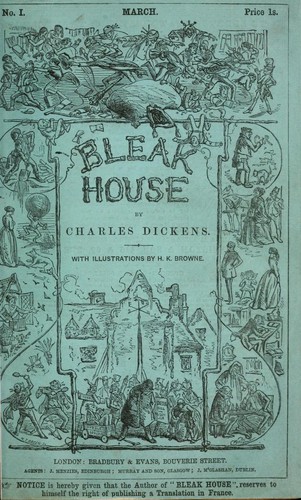
Bleak House
by Charles Dickens
Buy on AmazonAs the interminable case of Jarndyce and Jarndyce grinds its way through the Court of Chancery, it draws together a disparate group of people: Ada and Richard Clare, whose inheritance is gradually being devoured by legal costs; Esther Summerson, a ward of court, whose parentage is a source of deepening mystery; the menacing lawyer Tulkinghorn; the determined sleuth Inspector Bucket; and even Jo, the destitute little crossing-sweeper. A savage, but often comic, indictment of a society that is rotten to the core, Bleak House is one of Dickens's most ambitious novels, with a range that extends from the drawing rooms of the aristocracy to the poorest of London slums.
Recommended by
"This is probably Dickens’s best evocation of a society in which your origins more or less determine your destiny. My job is essentially about trying as best you can to detach people’s life chances and their destiny from their origins, so that where you are born doesn’t determine where you die. Of course the whole point about Bleak House is that both its heroes and its transgressors are involved in that struggle against their origins. Esther Summerson, the slightly weedy central character, is born into these rather rocky circumstances, nobody quite knows where she comes from and therefore it’s unclear where she’ll end up. Lady Dedlock, the most interesting character, is transgressing because she has risen to a place where she should never have been. She gets her comeuppance: that’s the Victorian idea that you have to be careful and you can’t overdo your rising up the scale. At the other end of the scale you’ve got poor Joe the crossing sweeper, whose fate is marked in his genes. He’s never going to be anything other than the dreadful, tragic figure that he is in the book. What Dickens is trying to do is to undermine, by satirising it, the idea that people get stuck in their fixed social positions. The other point of the book, in terms of what I do at the commission, is about the role of the law. Bleak House tells us not to rely on the courts for justice. In the end, a just society can’t be delivered by people in a courtroom. We do quite a lot of that, but it’s fundamental to the way I approach anti-discrimination and social justice, to believe that in the end what will change things is how people behave rather than judicial remedy. We have a vast range of judicial remedies, but the idea that you can tackle racial or sex discrimination, or indeed, much more significantly, class discrimination, as a feature of our society either by legal action or by the laws that are passed in parliament really seems to me rather limited – it’s a mistaken strategy."
Equality · fivebooks.com
"'Bleak House,' because I’ve learned so much from all of Dickens?"
By the Book: Anna Quindlen · nytimes.com
"In hospital I listened to Miriam Margolyes reading Dickens's "Bleak House," doing all the voices. Pure genius."
By the Book: Hanif Kureishi Shattered · nytimes.com
"I'll be rereading "Bleak House" one week and Carl Hiaasen or Elif Shafak the next."
By the Book: Ian Rankin · nytimes.com
"When I first read “Bleak House” in college, I was blown away by Dickens’s ability to create an entire world on the page. That novel has everything"
By the Book: J. Courtney Sullivan · nytimes.com
"I plan to go back to Bleak House, which I put aside during the holidays. It was like a boulder that was standing in the way of shorter books. Now I am ready to return to the wild terrain of Dickens's great work."
By the Book: Janet Malcolmn · nytimes.com
"Charles Dickens's "Bleak House," which has the greatest opening ever written (and the plot and characters to go with it)."
By the Book: Nathaniel Philbrick · nytimes.com
"Jo, the crossing sweeper in "Bleak House," is the character who has the most powerful effect on me whenever I return to that peerless book."
By the Book: Stephen Fry Odyssey · nytimes.com
Favorite books · radicalreads.com
"Bleak House is the work which most powerfully suggests the darkness of London, the close-packedness of London, if you like, where everything is connected to everything else. It is a London world where people are tightly bound together with ties of duty and ties of love and charity. And yet at the same time this London world is so perilous, so cruel and so close to death and disaster all the time, that you fear for the characters in the novel. The rich and the poor, the sick and the well all mingle together, which is one of the themes of the book. It is a serious London, full of mysteries of the past and mysteries of origin. In all respects it conveys a haunted city, half pantomime-half graveyard, and full of ghosts and unseen presences. Oh yes, you can find remnants of Dickensian London in various odd places, not so much as before the war, but still there are parts of London which for me have the sense and texture of Dickens. Yes, the Temple and also south of the river, like Borough High Street. There are parts of London which seem to be similar to 19th century London and manage to retain some of the atmosphere."
The Best London Books · fivebooks.com