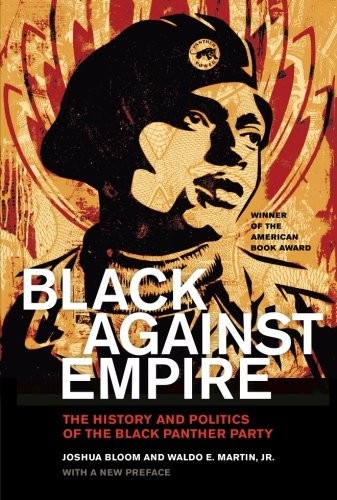
Black against Empire: The History and Politics of the Black Panther Party
by Joshua Bloom & Waldo E. Martin Jr.
Buy on AmazonI dedicated an entire chapter of my last book to the Black Panther Party and to this book. I found it randomly in a San Francisco bookstore, and reading it moved me it many ways. To me, the Panthers’ ideology, as developed by Huey Newton, Bobby Seale, Fred Hampton and so on, represents the less mythological and the most accurate way to do political theory and to think about the political condition. First and foremost, the Panthers redefined their situation by thinking of themselves not as a minority but as a colonised people. They stated that they considered themselves to be a population occupied by the American police, and that the various rebellions and riots in Black neighbourhoods were to be seen as liberation struggles. Under this framework, the law became an external force voted by certain white people in Parliament and applied to them without their consent. Support Five Books Five Books interviews are expensive to produce. If you're enjoying this interview, please support us by donating a small amount . Interestingly, the Black Panther Party is nowadays commonly portrayed as a violent movement. But not once in their history did they initiate violence. All they wanted, initially, was for the Constitution to be respected. They tried to do so by conducting armed patrols in Oakland, during which they followed police officers to prevent aggressions by the police against black citizens. With this method of ‘policing the police’, they were actually behaving in a very legalistic manner. This tendency to label a group as ‘violent’, when it actually wanted to fight state violence, is very telling. It’s as if in our political vocabulary, ‘violent’ referred less to a category of actions than to anything that is opposing the state. But the State of California quickly reacted by passing the 1967 Mulford Act that repealed the law allowing open carry of loaded firearms. That’s when the Panthers realised that the law wasn’t made to protect them, and thus it could no longer be their law. So they stopped thinking of themselves as a minority, and began to describe the black community as a colony within America, and the police as an army of occupation. It seems to me that this refusal of the idea of political belonging could be extended to the political condition in general: since your birth, you have had to submit to hundreds of laws that have been voted by governments you partly or fully disagreed with. It wasn’t your law, and voting it was a way for an external force to colonise your life. In classical political theory, there’s always an opposition between democracies and colonies. We tend to think of democracies as places where people govern themselves, and colonies as places where people receive their laws from a foreign power, such as Algerians under French rule. But simply because your head of government shares your skin colour and your nationality, it doesn’t make it any less of a colonisation process, philosophically speaking. The law is always somebody else’s law. “The Panthers’ ideology represents the most accurate way to do political theory and to think about the political condition.” If you push this to its extreme, democracy—in the way it exists today—becomes a meaningless concept. The idea of a people that governs itself is devoid of meaning. A people is a space inside which some individuals are governing others. Voting is using the state to submit a stranger to your will. This is why a political relation is by definition a colonial relation; we’ve never left the colony. Of course, my own situation cannot be compared with the situation of Algerians before 1962 or Black Americans; it would be indecent to say that. But the difference must be established by comparing the concrete nature of power relations, living conditions, and rights. We need to eliminate from our political language the ideas of ‘democracy’ and ‘self-determination’, because they are, in effect, impossible. Indeed, throughout their history, the Black Panthers managed to be the avant-garde of radical politics in the United States in the late 1960s. In both its practices and its politics, the party was revolutionary in a very complete way, by supporting many struggles in American society and around the world, and by creating alliances between separate struggles. There’s a very beautiful quote by Huey Newton who, as early as 1970, linked homosexuality and revolution, going against those who associated homosexuality with bourgeois decadence: “maybe a homosexual could be the most revolutionary”. It’s important to remember this idea today, as we see a tendency to sometimes oppose the LGBT movement and the anti-racist movement. There is a tendency today, in some parts of the radical Left, to reject organisation and leadership, thinking that social struggles can spontaneously rise and act efficiently. But pragmatically, building a movement means taking time to talk to people, help them meet one another, print leaflets, organise events, and so many other things. And this can’t be done spontaneously. There’s nothing wrong with leading people. Strong movements need strong leaders who can embody a struggle, carry the voice of others, help generate identification and cast a message that will be heard by the media.