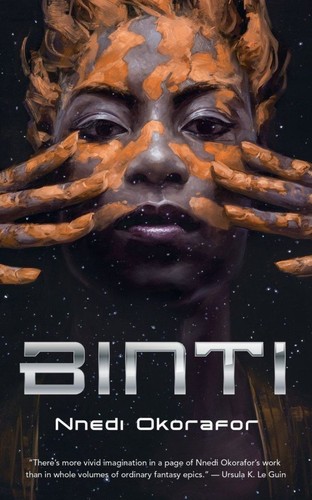
Binti by Nnedi Okorafor, is a trilogy and the third part is out in January 2018. I discovered these books recently, loved them and began following the author online. Like Le Guin, these books are set in different worlds and the characters are not all human. But they all, in some way, conform to certain psychologies that are recognisable to us. Her thought experiment is concerned with the nature of humanity and she plays around with ideas and problems that occur in our society. Nnedi Okorafor is a Nigerian-American author and she writes about tensions in our world, particularly how people of different races and cultures interact. She does so in ways which are challenging and illuminating. The main character faces situations where she must adapt and empathise—she must change but not lose her own distinctive identity. Everywhere she is the outsider. And an outsider in societies that are at best uncomprehending, at worst, incomprehensibly awful. How you navigate all that while remaining true to yourself? It’s a fascinating question. This idea of different types of intelligence, different kinds of understanding, different ways of seeing the world—to be able to see things that other people can’t see.
"Binti by Nnedi Okorafor, is a trilogy and the third part is out in January 2018. I discovered these books recently, loved them and began following the author online. Like Le Guin, these books are set in different worlds and the characters are not all human. But they all, in some way, conform to certain psychologies that are recognisable to us. Her thought experiment is concerned with the nature of humanity and she plays around with ideas and problems that occur in our society. Nnedi Okorafor is a Nigerian-American author and she writes about tensions in our world, particularly how people of different races and cultures interact. She does so in ways which are challenging and illuminating. The main character faces situations where she must adapt and empathise—she must change but not lose her own distinctive identity. Everywhere she is the outsider. And an outsider in societies that are at best uncomprehending, at worst, incomprehensibly awful. How you navigate all that while remaining true to yourself? It’s a fascinating question. This idea of different types of intelligence, different kinds of understanding, different ways of seeing the world—to be able to see things that other people can’t see."
"Binti is a sixteen-year-old girl of the Himba people, who are in Namibia. She is a mathematical genius, and she does things in the story that I don’t understand. It’s so advanced, and I am terrible at math, but I find it very fascinating; it flies over my head, and I love that. The story doesn’t ride on me understanding how equations work anyway. Binti is the first of her people to leave the planet. She’s leaving for Oomza Uni, which is a huge university. On the way there, terrible things happen, because of another people called the Meduse… But somehow, Binti can communicate with these people, who have been enemies of humans for a very long time. It’s a coming-of-age story, but it’s also a first contact story, where you sort of solve problems by communicating. It’s about ending cycles of violence. I am absolutely fine with it, but maybe that’s also because English is not my first language, so when I started reading in other languages I got used to not understanding everything. I would get the meanings from context. It’s embarrassing to tell you how many years it took for me to figure out what the word ‘breeches’ meant because I kept coming across them in all the fantasy novels… I also have dyscalculia, so equations are my special nemesis. Some things are very easy to understand, but math is very difficult, and linguistics is very difficult. To go back to Ted Chiang’s story – he does an analysis of how language works, with clauses, subclauses and stuff like that. And I tried to study that at some point, but it’s not my thing. Yes. I really enjoy being unsure what all the rules of engagement are. I know that a lot of people are annoyed when they don’t get all of it, but I love it when there are unexplained things, that I may never get the explanation for. That’s maybe also why I love The Mothman so much, because we’re never going to know. I think in Binti , it comes down to figuring out what someone’s internal logic is. This is also something I think about when I write, and the way I think in relationships as well: you can understand the motives for pretty much everyone’s actions, if you just know what the internal logic is. People are rational within their own system. Binti realizes how these Meduse work; she figured out what is important to them. That’s how they communicate. I think that’s also part of my mission when I write: I’m very interested in befriending the alien and the weird, and that’s a common theme for all of these books. It’s the opposite of H P Lovecraft, who said that there’s nothing more frightening than that which you do not understand. Whereas my feeling is: let’s try and figure this thing out. Yes. First, Moominpappa at Sea by Tove Jansson. The Moomins were marketed as children’s books, but they have so many layers, and you can read all of her books as an adult and take so much away from them. Here Moominpappa has a midlife crisis – he is starting to feel unimportant and decides that he’s going to take the entire family to live on an island with a lighthouse so that he can ‘protect’ them. I think it’s the best depiction of the male midlife crisis that I have ever read, including everyone else who has to deal with it. My other tip is one that I just finished, which is The Death of Mountains by Jordan Kurella. It’s amazing. The main character is a mountain, and the mountain is about to die; there is a specific Death of Mountains that is coming for them, and they have a conversation. The mountain is thinking about how humans have walked on them and dug into them, hurt them, but also delighted them. What is wonderful about this little book is that it’s not us looking at nature: it’s nature looking at us."