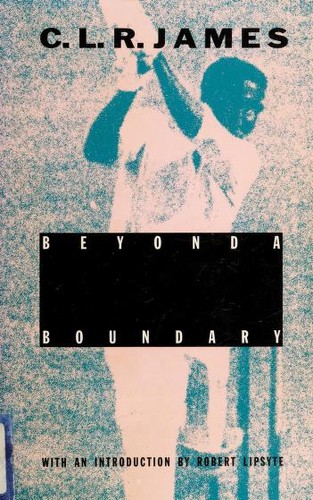
Beyond a Boundary
by C. L. R. James
Buy on AmazonThese aren’t just my choices; I’ve asked some of the other commentators as well. I’ve discarded four out of five from one commentator, but almost everybody agreed on one book, which is Beyond A Boundary by C L R James. A social metaphor. When cricket writing started it encouraged a lot of upper middle-class snobs to say rather twee things about how charming it was that blacksmiths were bowlers and people who didn’t have to work always batted at number four: a series of tedious stereotypes somewhat reminiscent of Lytton Strachey’s Eminent Victorians. I was brought up with that tradition, but also at a time when the West Indies were murdering Britain, and these wonderfully athletic, lithe black men were smashing the shit out of a load of public school boys, a spectacle that didn’t square at all with Lytton Strachey or Neville Cardus or E W Swanton. It’s probably the most famous cricket book of all time, written in 1963, and in it, the most beautiful quote: ‘What do they know of cricket who only cricket know?’ It’s a quote that encapsulates everything that’s important about life and, of course, cricket, because cricket’s full of people who know nothing else, statisticians and bores… What’s far more important are the things that James is writing about. He’s a Trinidadian, born at the turn of the century, just as Trinidad is being decolonised; slavery’s gone, the country’s experiencing this hang-over from the Empire. There are still cricket clubs based on the colour of your skin. Imperial politics and cricket are inseparable. It’s the sport of Empire and, unlike other sports, it’s extremely limited in its range of interested countries. It just so happens that those countries are enormously influential: England, Pakistan, India – over a billion people there – Sri Lanka , Bangladesh , New Zealand, Zimbabwe , South Africa , Australia and all the Caribbean islands. James is a Trotskyite. He’s talking about cricket as a vehicle for political representation, where the team is a kind of Marxist collective, with each member performing a different role in the group. And that’s particularly relevant to a team like the West Indies, made up from a group of independent countries, but discovering its identity through this kind of co-operative: a spin bowler from St Lucia, a wicketkeeper from Trinidad, a batsman from Barbados. They all have equal importance while being totally different, and on the cricket field, too, you can be equal to the white man who has controlled your society. And so learned. Get this: ‘T S Eliot is of special value to me, in that in him I find, more often than elsewhere and beautifully and precisely stated, things to which I am completely opposed.’