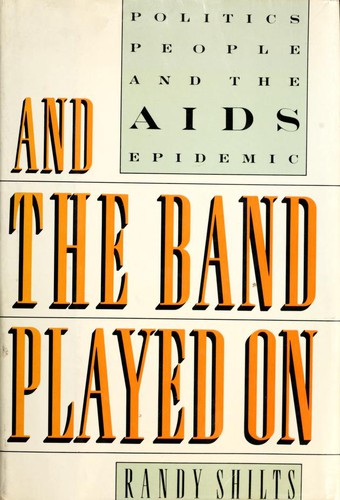
And the Band Played On
by Randy Shilts
Buy on AmazonThe blueprint of 20th century investigative journalism. Tracing the course of HIV/AIDS through society; from its earliest as then unknown incarnation, to the height of this 1980s hysteria – the death of Rock Hudson: Shilts's book should be in every High School's final academic examinations coursework reading list, as a compulsory item. An unregrettable read.
Recommended by
"Randy was a San Francisco Chronicle newspaper reporter and knew the gay community well. He saw the Aids epidemic evolving. He was concerned because his friends were infected and some of them were dying. He would come to my office at the university once a week and ask, ‘What’s new?’ He did that not just with me but also with Dr Volberding, a hematolgist, Dr Conant, a dermatologist, Dr Greenspan, an oral surgeon, and dozens of others who were immersed in the new epidemic. He was writing and documenting how this epidemic was expanding and taking the lives of more and more young gay men. Randy was also wrestling with the contribution of behaviour to this epidemic. Why this epidemic? Why this population? We have to remember that when he started writing the book, the virus wasn’t known. It wasn’t discovered until 1983—and a test for it wasn’t approved until 1985, when the epidemic was in full force. The book is not an easy read because it’s not written in a narrative form, it’s written in a journalistic form. But it’s the first book that really documented the details of the spread of the virus, primarily among young gay men. When he spoke to me, we were dealing with the other ways that HIV was transmitted—from infected mothers to their babies and through blood transfusion. He writes about that in the book but it’s not a major part of it. “One of the early names for Aids was Gay Syndrome” He documents the spread of the virus from very small communities of people to countrywide—and how that happened. I think he was fair in the way he wrote, although he’s been criticised by a number of people for being too personal. Randy pointed out how opposition to the emerging epidemic came initially from denialism: ‘It’s not going to affect other people, it’s confined to a small group of gay men who are very sexually active.’ And Randy documents that, yes, that’s how it spread in the gay community. But that is not where it remained. The people who didn’t believe ranged from politicians as high as the president of the US—Ronald Reagan never acknowledged that Aids was a problem until the end of his second term. And the NIH [the National Institutes of Health]—which prides itself on early recognition of disease and doing research on it—denied that it was serious. Journal editors didn’t want to publish some of the articles written about Aids. There was this incredible discrimination against gays because it was portrayed as being primarily a gay disease. One of the early names of the disease was Gay Syndrome. Randy, in putting all of this together, shows how what became a global epidemic was resisted at the early phases—with dreadful consequences. He does it by putting names in the narrative. Randy does the best job—out of these five books—of really outlining opposition to a plague and where it comes from and identifying the obstacles to acknowledging that there is a new infectious disease that is going to threaten the world that we have got to take seriously. Maybe the evidence isn’t complete yet but it’s enough to act and we have to react quickly. It starts where Randy ends. Randy died in 1994, just as these potent new drugs were being developed. As the epidemic Randy was documenting progressed, he got into the delays in treatment. Here in the US, the first drug that was available, AZT, could have been developed and gotten to HIV-infected individuals more quickly. New drugs followed so that by 1996 there were some twenty drugs that could be used to treat HIV―in combination. They were potent and could halt disease progression. When the data came in on treatment with the new drugs it showed that there had been a major change in the epidemic. People who were infected were living longer, they weren’t having to go to the doctor as frequently, and they weren’t hospitalised as frequently. There was even data that people who were on treatment did not transmit the virus as easily as people who were not on treatment. I start the book back in Randy’s time, 1981, but take it past when Randy was no longer alive and show how here, at last, were all of these discoveries which were changing the face of HIV/Aids in wealthy countries. We had the International HIV/Aids Conference in Vancouver in 1996. There were some 8,000 HIV/Aids specialists there. People like David Ho and Luc Montagnier were saying that we have to treat everybody who is HIV-infected, regardless of their clinical condition or immunologic status. That was the consensus among the majority of the scientific community. But some clinicians felt that the recommendation did not apply to certain populations, especially women and children in poor countries. This was really difficult to understand. I had a suspicion that they reached this conclusion because they had a true conflict of interest—that their research studies and funding depended on answering a question which had, in fact, already been answered. That’s where my Lethal Decisions comes in. How did decisions to withhold treatment and continue research to prove what had already been proven happen? What were people thinking—scientifically, ethically, public-health-wise? Did they know they were making decisions that would continue the epidemic? I had to continue the story of the battles that Randy had pointed out, showing they didn’t go away. They just took a different form with equal or much more serious consequences because the epidemic was now not 10,000 new cases in a year, it was a million new infections in a year. It should never have happened. It was a blot on US government-funded clinical research, the integrity of clinical researchers, and a failure of public health to do what could have saved millions of lives. That’s why I wrote the book. Yes. Let me give you two examples. At the Vancouver meeting in 1996, HIV experts said everybody should be treated. The World Health Organisation is at the meeting and the head of it says that we’ve got to develop guidelines for treatment based on these new clinical research findings. But only in 2002 does WHO publish their first guidelines. That’s a six-year gap between what the scientific community is saying―everybody should be treated—and WHO writing their guidelines for the world. Then you pick up the guidelines and WHO says that they don’t believe—here’s the denialism—that the evidence is strong enough to treat everybody. They recommend that only the sickest of the HIV-infected individuals be treated. i.e. with people that were infected, you should withhold treatment until they get sicker. That was unprecedented. The tables should have been immediately turned and WHO asked, ‘What evidence do you have that delaying a known, effective treatment is of any benefit?’ I couldn’t believe it. As a doctor, you use what treatment is available and what you know works. It would be unconscionable and malpractice to withhold treatment from someone and wait until they got sicker. If you had cancer and the doctor told you that we have a drug to treat your cancer but we’re going to wait until it goes to the brain or the lung before we treat it, there would be a massive outcry. Not everyone is going to agree, but I think there were two reasons. Normally when people say they don’t believe some information, it’s because there’s some sort of ramification for themselves. In the case of HIV, with WHO, one reason was that they wanted to look good in the world of public health. They had been criticised repeatedly in the scientific and academic world and the media for not responding quickly enough to other epidimics. So they put spin on what they were doing. Say you need to treat everybody who is HIV infected—let’s say that’s 30 million people. Then you’ve got to treat all of them or you don’t look so good. But if you say, ‘Well we don’t believe the data is strong enough that everybody should be treated, we think you should only treat the sickest patients.’ If you treated only 3 million and say that they are the ones who needed treatment (and not all 30 million) then you might look good in the world’s eye. Maybe they just couldn’t acknowledge that they were failing by treating only 10% of those who really needed it. Another reason that people tell me was that WHO used an economic argument that was short-sighted and incorrect, postulating that there wasn’t enough money to treat all individuals using these expensive drugs. I don’t accept that because when the cost of the anti-retroviral drugs came down from $5,000-6,000 a year to $100 a year they didn’t change their guidelines on who should be treated. Also, the true cost of the Aids epidemic includes clinic visits and hospitalizations. Had all HIV-infected individuals been treated these costs would have plummeted. Three years ago they finally capitulated and said everybody should be treated, but never acknowledged that they were incorrect in 2002. So, it’s an enigma. In other epidemics, is there any example where effective treatment for an infectious disease was withheld? I can’t find any documentation, including published medical literature. So, in the Aids epidemic, the decision to allow the epidemic to continue by not treating the majority of those who were infected clearly set a new precedent. Life-saving treatment was withheld from people who were infected until the disease progressed and they died."
HIV/Aids · fivebooks.com
By the Book: Siddhartha Mukherjee · nytimes.com
"Eventually a few years later I would read Randy Shilts’ masterpiece And the Band Played On , which is, in some ways, an even more harrowing vision of what a world without marriage finally looks like. Yes. And this is a world where people are debating whether to leave sex clubs open – even though they are immense transmitters of disease. In those days we didn’t have marriage, we had sex clubs. They were our community centers. That’s what happens in a culture without marriage. You get these very strange substitutes. Both of those, the AIDS culture and the promiscuity culture, scared the pants off of me. Well along came the late 1980’s and I was working in Washington as a journalist for the National Journal . I’m writing about economic policy and I run into an economist by the name of Sar Levitan. A delightful European guy. He died quite a number of years ago, unfortunately. And Sar was a deeply honest liberal academic – liberal in the American sense, from the moderate left. Now these were the days when the main people who talked about the breakdown of the American family were the religious right, and they did it in a way that was anti-gay."
Marriage · fivebooks.com