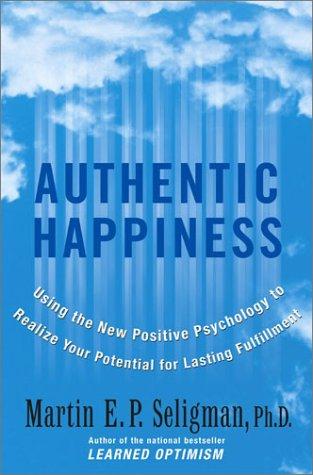
Authentic Happiness
by Martin E P Seligman
Buy on AmazonWhen I heard the title I thought, Oh God! What a title! It’s so American. But I like it because I read Seligman’s work way back when I was a psychology student. He was the man who gave us ‘learned helplessness’ – why men don’t learn how to use washing machines. He did experiments shocking dogs and noticed that two or three out of every ten dogs wouldn’t just lie back and be shocked, they would try to escape. And instead of focusing on the helpless ones, he looked instead at the resilient ones, and set out to find out what made them resilient. What is good about this book is that it puts together lots of his work, as well as lots of other psychologists’ work, in a way that is absolutely readable. It’s also very practical – it tells you why happiness matters, what you can do about it, and how to go about it. Psychology has always been about fixing the broken. The standard huge tome that is beaten into all psychology students is called DSM3R, which is diagnostic. How do you tell if someone is a schizophrenic, or if they’ve got depression, or if there is something worse going on? And Seligman said, ‘Hang on, what works? Let’s focus on what works. How do you get more of what works?’ Because just fixing the broken is very, very downbeat. He also argues that we should be grateful for bad experiences, because you only grow by going through tough stuff. You may not like it at the time, but afterwards you benefit from it. So Seligman is the founding father of positive psychology, though in real life he’s Mr Gloom. He acknowledges that at the beginning of the book, which is very sweet. I’ve seen him lecture and he turns up in a terrible bait, and it’s so funny to have the founding father of positive psychology sitting there in this terrific bait. But it’s a very positive message – think about your strengths and what you’re good at, even if some of them felt a bit a cheesy to a Brit. Could you walk into work and say, ‘My top strengths are my love and my spirituality and my wisdom’? That wouldn’t feel too good to a Brit. But it’s a very uplifting message and approach to life. For example, how you argue with yourself when you’re in a low place. He gives you four ways – A E I U. A: what are the alternatives to the situation? The E is what is the evidence you’ve got that you are a hopeless person? The I is what are the implications for you of thinking I am a hopeless person? U is the useful bit: is it useful for me to continue thinking like this? And for me it’s just practical. You can challenge yourself and you can challenge other people. When someone goes: ‘Oh my God, 15 of the team have just been laid off, you and me are going to lose our jobs next.’ You can start disputing: what is the evidence for that? What are the alternatives we’ve got? What are the implications of 15 people being laid off? And that takes you from the past to the future. The usefulness is your own challenge – going around and around in your own brain isn’t very useful. That’s one of the things that makes you depressed, rumination – when you just have these thoughts going round and round in your brain, and you don’t talk about them, and you don’t challenge yourself. Introverted ruminators get depressed. But I don’t like telling people that.