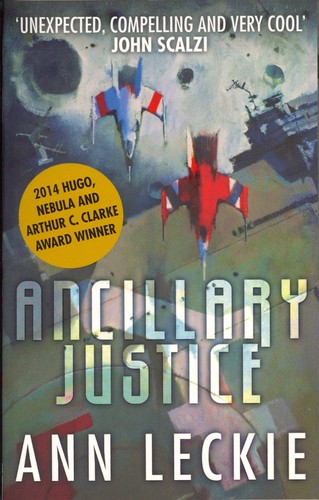
Ancillary Justice
by Ann Leckie · 2013
Buy on AmazonOn a remote, icy planet, the soldier known as Breq is drawing closer to completing her quest. Once, she was the Justice of Toren--a colossal starship with an artificial intelligence linking thousands of soldiers in the service of the Radch, the empire that conquered the galaxy. Now, an act of treachery has ripped it all away, leaving her with one fragile human body, unanswered questions, and a burning desire for vengeance. Sequels: Ancillary Sword; Ancillary Mercy.
Recommended by
"In this thrilling and complex first novel from Ann Leckie, we plunge into a world of astro-political intrigue. Our hero is on a vendetta to destroy the rulers of a colonial empire that destroyed her starship – but as we read, this typical space opera plot turns into a rich story about how imperialism transforms civilizations as well as the most private thoughts of the individuals in them. We find that our ninjalike hero is actually the fragment of a hive mind that once controlled a starship, and her mission has its roots in a political conflict that stretches back 1,000 years. Come for the page-turning action, and stay for the astonishing character development and world building that will leave you in awe."
NPR Books We Love — 2013 · apps.npr.org
Hugo Award for Best Novel — Winners · en.wikipedia.org
Nebula Award for Best Novel — Winners · en.wikipedia.org
"I was so pleased that this qualified as a work for my top five. Ancillary Justice was published in 2013, and it won every single prize in 2014, including the Arthur C Clarke Award, the year before I was a judge. Also the British Science Fiction Award, a Hugo Award, a Nebula Award . . . It won absolutely everything. It is also a political book, but a political book that takes the traditional space opera universe . . . I think I’m right in thinking that it’s the only book of the five that we’re discussing that’s got spaceships in. Well, spaceships make an appearance in The Left Hand of Darkness and The Dispossessed and in Dune , but they’re not really core elements of the plot, whereas spaceships really are a core element of the plot in Ancillary Justice . Support Five Books Five Books interviews are expensive to produce. If you're enjoying this interview, please support us by donating a small amount . It’s about a future war and the dialogue between people and artificial intelligences. There’s also a very interesting gender aspect to it as well, in that her protagonist doesn’t distinguish people by gender. Her protagonist is actually an artificial intelligence, a computer personality. Therefore, because the protagonist doesn’t perceive gender, it uses ‘she’ and ‘her’ for all human beings: ‘She has a big red beard.’ That kind of thing. It’s even more subversive than the Ursula Le Guin approach to gender and makes us think: Why do we say that? What’s really going on in our minds? What is at first presented as a slight deficiency in the way that the computer intelligence sees the world, makes us realise it’s a deficiency in the way we’re seeing the world. Yes. I think it facilitates that sort of experiment in a way that is more difficult for a mainstream writer to pull off, because science fiction writers are expected to do something new and imaginative. In a sense, the bar of credibility is a bit lower than if it were, say, Martin Amis. On top of that, I would also say that science fiction fandom has really turned a corner and is demanding creative thinking from writers on fundamental issues like gender and sexuality and race in a way that, perhaps, mainstream readers are not demanding of their writers. Maybe I’m overgeneralising, but I have this sense that there is a bit more of an activist edge to science fiction fandom these days. I think it was always there; Asimov and Heinlein were both politically active in their different ways. Clarke wasn’t particularly. Now, it’s increasingly coming with the territory."
The Best Sci Fi Books for Beginners · fivebooks.com