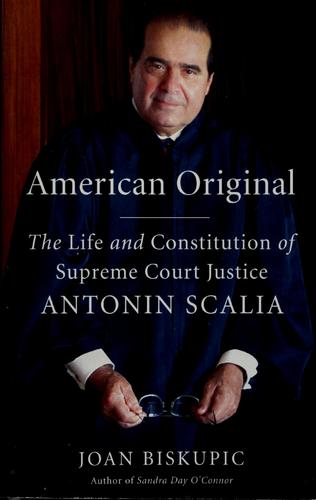
American Original
by Joan Biskupic
Buy on AmazonA profile of the conservative Supreme Court justice offers insight into his absolute belief system and considerable body of work, evaluating Scalia as an "apex of power" whose opinions may have far-reaching consequences in the social counterrevolution.
Recommended by
"If you are going to read a biography of a sitting justice, you can’t go wrong with Scalia because he’s a flamboyant literary character. Joan Biskupic is one of my favorite court watchers because she really tries to understand the psychology of a justice. She goes back in Scalia’s biography, and pretty much confirms that the Scalia that sits on the bench today is the same Scalia who grew up in New Jersey, the debate champ who couldn’t get into Princeton. He was sealed in amber at pre-adolescent age as what he is now – a brilliant, passionate and deeply gifted writer and thinker. Joan goes back and figures out what made him such a Shakespearean character on a court of people who sometimes seem like black-and-white characters. One of the things that she mines is that although Scalia has nine kids, he was the only child in a whole generation of his Italian immigrant family. His mother was an outgoing, gregarious storyteller and his father was scholarly, withholding and demanding. He’s a blend of both of them. He’s a devout Catholic who had a really adverse reaction to the 60s and 70s. He’s so certain of himself, so brilliant and so bombastic. I would say that he is the most influential conservative justice on the court, because his writing is so persuasive, but he’s written so many blistering lone dissents over the years that he has angered some colleagues. He always says, “I’m just writing my dissents for the law students; I gave up on persuading anyone.” But the fact is that he has a huge impact on the direction of the law. For instance, he is seen as the prime mover in District of Columbia v Heller, the case that tested the DC handgun ban and addressed, for the first time in decades, the question of whether there was a fundamental right to carry a gun [in the US]. For years people said don’t even bother bringing that to the court, because there’s no plausible argument that the Second Amendment, on its face, allows for an individual’s right to bear arms. Scalia wrote the majority opinion. Biskupic ends her book with this tour de force of his constitutional views, in which he divines the original intent of the framers and mines constitutional history for the original meaning of their words, while railing against living constitutionalism or jurists’ attempts to keep up with modern values. Helleris a triumph not just of Scalia’s political view that we should have the right to bear arms, but also of his interpretive method. He has five votes now for his way of reading the constitution. The most interesting thing about the duck-hunting extravaganza is Scalia’s memo to the American people, explaining at length why he wasn’t recusing himself. It was incredibly persuasive. What he said was: Look, Supreme Court justices have been palling around with presidents and vice presidents since the founding. If you think this is the first time a justice has ever socialised with someone important, think again. Then he makes a persuasive case for why there’s no conflict. Scalia is brilliant at convincing you that you’re wrong about something that you know, in your heart, to be right. He’s better at that than anyone. In that memo you also see his pugilism. He refuses to retreat into the court. He could have just said, I’m not going to respond. Instead he reached out and wrote this detailed letter explaining himself. That, to me, was the real importance of the duck-hunting scandal."
US Supreme Court Justices · fivebooks.com