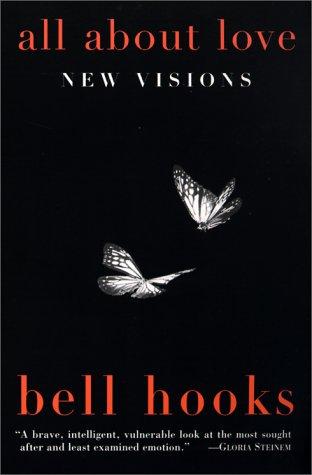
All About Love: New Visions
by bell hooks · 2000
Buy on AmazonAll About Love offers radical new ways to think about love by showing its interconnectedness in our private and public lives. In eleven concise chapters, hooks explains how our everyday notions of what it means to give and receive love often fail us, and how these ideals are established in early childhood. She offers a rethinking of self-love (without narcissism) that will bring peace and compassion to our personal and professional lives, and asserts the place of love to end struggles between individuals, in communities, and among societies. Moving from the cultural to the intimate, hooks notes the ties between love and loss and challenges the prevailing notion that romantic love is the most important love of all.…
Recommended by
Our Shared Shelf — Complete Picks (2016–2019) · goodreads.com
"All About Love by bell hooks is an optimistic book, a little sermonic at times, which draws upon the Spanish mystic Teresa d’Ávila, Trappist monk Thomas Merton, American philosopher and activist Cornel West, as well as psychologists like Erich Fromm and M. Scott Peck. hooks – who spells her pseudonym in lower case because she wants the focus to be on her ideas and not her name, although I suspect lower case brings more attention to her name – argues that love can be transformative, both individually and socially, but we’re not taught to love well, we’re not taught what love is, and we’re not talking about love in any meaningful way. She says that the family is meant to be the original school of love, but most families are dysfunctional. Quite often, they’re hotbeds of psychological terror and autocratic, patriarchal realms of power and domination. She’s particularly critical of the nuclear family because it encourages women to be dependent on individual men and makes children dependent on individual women, which makes abuse of power easy. She was an advocate of more communal family structure. True, and yes, she is particularly critical of the heteronormative, traditional structures and doesn’t address homosexual relationships in any detail. Some philosophers we have discussed do talk about homosexual love. For Plato in Symposium, male homosexual love is the highest type of relationship. Beauvoir says in The Second Sex that lesbian loving can provide a model of the ideal authentic reciprocal relationship she had in mind. Still, hooks is interested in the practice of love in everyday life for love in general. “For Plato, male homosexual love is the highest type of relationship” One of the problems she sees is that we tend to treat love as a noun, when really it’s a verb. Love is as love does, she says. This reminds me of Jean-Paul Sartre’s idea that love only exists in the deeds of love. Similarly, for bell hooks, love is a choice and an action. So love doesn’t exist if there’s abuse in the relationship, because you’re not acting lovingly. She also brings in a spiritual element; she defines love as nurturing your own and another person’s spiritual growth. Now, what she means by ‘spiritual’ is somewhat ambiguous, but her vision is for a more interconnected society; love should be an active force that creates greater communion with one another, but we’re far from achieving anything like this, and capitalism is partly to blame. Capitalism exploits our confusion about love because we’re bombarded by advertising that is trying to convince us that our emotional void and our spiritual hunger can be filled through materialism. Many people define themselves by the mentality ‘I shop therefore I am.’ We’ve become a mass-consumerist culture and, hooks writes: “We may not have enough love but we can always shop.” We’ve come to worship money and possessions, which makes us more narcissistic, and that’s a problem for our relationships too, because it tempts us to see them as disposable. She’s urging us to give up the will to shop, our will to power over one another and, instead, learn to love better because, as Thomas Merton wrote, “we discover our true selves in love.” She’s talking about love between any kind of human beings – love of children, love of friends, love of things, as well as love of romantic partners. I teach ‘Philosophy of Love and Sex’ at the City College of New York and it’s a popular class. It’s always at capacity. I don’t know why more philosophy departments aren’t offering this as a main topic. Philosophy has always been about love. It means love of wisdom. Beyond that, it is a fascinating theme that affects all of us. Students do come in with a lot of preconceived expectations. Many believe in soul-mateship, so I often start with exploring the roots of that myth with Plato’s Symposium and the Aristophanes story that we used to be creatures with two faces, four arms and four legs. One day we upset the gods and Zeus split us in two and since then we’ve been searching for our ‘other half’. Some students assume that love is just a matter of biology or survival of the species. Many of their assumptions are heavily influenced by religion or pop culture. I hope that they leave with a lot more questions than answers, and have some of their prejudices shaken. And that tends to be the case, by showing how many different ways there are to think about love and introducing criticisms of some of the common assumptions about relationships. Recently I came across Mary Wollstonecraft’s Vindication of the Rights of Woman , which is another under-appreciated work . Wollstonecraft writes that because women weren’t educated, they spent their time trying to inspire love rather than pursuing more noble ambitions. She described marriage as legal prostitution because men wanted to enslave women, and women wanted to fall in love with men who were wealthy enough so that they could survive socially and live comfortably. This was England in the late 1700s, and Wollstonecraft advocated for education for women and equality of the sexes, because then, she hoped, that boys wouldn’t be so debaucherous and selfish and would treat women as human beings rather than as objects of lust; and girls wouldn’t be quite so caught up in frivolous pursuits which make them weak and vain and arrogant. Love: A Very Short Introduction by Ronald De Sousa is a good concise synthesis of thinking about love. He argues that love is a condition or a syndrome, that involves emotions as well as thoughts, desires, and actions revolving around another person. He discusses polyamory, too, as does Carrie Jenkins in What Love Is: And What It Could Be . She proposes that love has a dual nature: it’s both biological and social. For example, love with a robot can’t be romantic because the robot lacks the requisite brain chemicals and the biology. She notes that society is starting to change to allow for more possibilities in relationships, such as same sex marriage, and hopes that society will become more accepting of other types of consenting adult relationships, particularly polyamory. I would also recommend Alain Badiou’s In Praise of Love , a short manifesto in which he describes romantic love as a tenacious adventure that gives meaning and intensity to our lives. And, for the serious student, there’s also The Nature of Love by Irving Singer – a massive three-volume history of the philosophy of love."
Philosophy of Love · fivebooks.com
""All About Love" taught me how to love; that love is a verb."
By the Book: Ibram X Kendi · nytimes.com