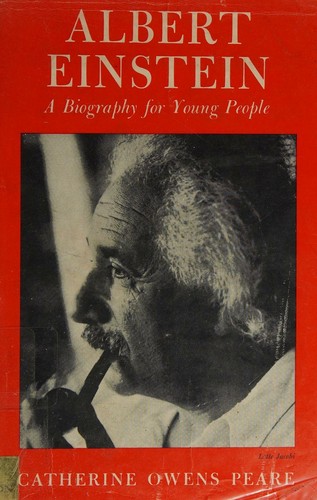
Albert Einstein: A Biography
by Albrecht Folsing
Buy on AmazonIt’s comprehensive, for a start. It is a very big book — one of the biggest on Einstein’s life. Fölsing is a physicist by training so he is able to bring clear explanations of the physics into the life. He’s extremely good at quoting Einstein’s writings and comments in an illuminating way. What makes the book unique is that the author is German, when most biographers come from the English-speaking world. He is able to present Einstein’s ambivalence towards Germany both in physics and in politics and bring that to life in quite a subtle way. To have a German writing on Einstein is particularly interesting. He was born in Germany in 1879 and grew up there until he was 16 when he went to join his parents in Italy. He was unhappy with the German educational system: He was not a very willing student in an authoritarian education system. In fact, his whole life was a battle against authority in different forms. Later in life he said—and it’s one of my favourite quotes from him —“To punish me for my contempt for authority, fate has made me an authority myself.” Finally, he was educated in Switzerland and that’s where he really belongs. He kept Swiss nationality throughout his life, until he went to the United States and became an American citizen when he was quite old, in 1940. So, he is not German by nationality, though he was born there. “He was not very successful in his relationships with his university lecturers.” The Swiss atmosphere was very productive for his physics, which started in about 1905 with special relativity and some other key work. He stayed in Germany until 1933, when the Nazis came to power, and he had to get out. He spent a little time in Europe, including in Britain in the early 1930s. Finally, he left Europe forever—never to return—in 1933. He lived in Princeton, New Jersey, at the Institute for Advanced Study, a sort of ivory tower. That suited him very well. He could just think and didn’t have to do any teaching. He lived in Princeton right up to his death in 1955. In that period he wasn’t so successful as a physicist — but became much more involved in political causes like the atomic bomb, the hydrogen bomb, pacifism, and Zionism. As a Jew, he was very interested in the founding of Israel and took an active role in that. That’s right. That’s always going to be one of the most intriguing aspects of Einstein and his life. He was a patent clerk in Bern and worked in the patent office for a number of years from 1902. After 1909/1910, he finally takes a position as a professional, academic physicist and moves to various institutions around Europe. Probably his most productive years are those years when he was a patent clerk. Having said that, he came up with general relativity when he was a professor of physics in Berlin. Also, at the patent office, although he was not known in the academic world, he had some contact with academic physicists like Max Planck who was a key supporter of relativity. But we should remember that he was always involved with those two worlds. Yes. It’s difficult to pin that down but from an early age—from his teens onwards—he was a great believer in self-education. Like many geniuses, he was not particularly successful in his university training. He attended a famous institution—in Zurich—but was always rebelling against his academic education, constantly reading the latest research on his own. He was not working with other people at all. He was not very successful in his relationships with his university lecturers. He was a rebel and, because he was so passionate about physics, his best ideas really came from his own reading and thinking. From his earliest days as a teenager he was a believer in what he called ‘thought experiments.’ He wasn’t involved with laboratories at all, these experiments were all in his head. One of the most famous ones concerns chasing a light ray. When he was 16 or 17, he imagined whether you could catch up with a light ray and what that would mean. Yes, to begin with, it did. But it’s important to recognise that he was always comparing his ideas with experimental results and, after his miracle year of 1905, attending conferences and involved through correspondence with leading authorities. He did work alone—there’s no question about that—but he also had a lot of sounding boards. He had friends who he tried his ideas out on and often they disagreed—quite violently in some cases—and that improved his thinking. At one point, he did have a collaborator who was a mathematician and they published some work on general relativity together. That’s the only collaborative work that was ever published. Afterwards, he always published alone.