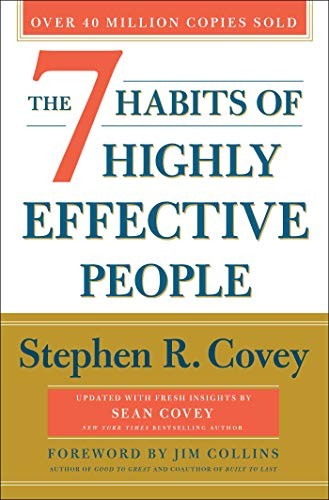
The 7 Habits of Highly Effective People
by Stephen Covey · 1989
Buy on AmazonNew York Times bestseller—over 40 million copies sold The #1 Most Influential Business Book of the Twentieth Century One of the most inspiring and impactful books ever written, The 7 Habits of Highly Effective People has captivated readers for nearly three decades. It has transformed the lives of presidents and CEOs, educators and parents—millions of people of all ages and occupations. Now, this 30th anniversary edition of the timeless classic commemorates the wisdom of the 7 Habits with modern additions from Sean Covey. The 7 Habits have become famous and are integrated into everyday thinking by millions and millions of people. Why? Because they work!…
Recommended by
"this was from originally Stephen Covey — the 7 Habits of Highly Effective People I believe was the book."
Books from The Tim Ferriss Show: How to Quiet the Ruminative Mind · youtube.com
"A truthful, universally authentic fact can make that kind of difference in somebody's life. I owe him the greatest debt."
Books from The Tim Ferriss Show: Steve Young — From Super Bowl MVP to Managing Billions · youtube.com
"I’m not so keen on that one. I think visualization is a very good thing, but not at your funeral. I don’t think you’ll care, because obviously you’re not going to be there. I do think you should think about where you want to be in ten years’ time and visualize it very closely and in great detail. Then you can start looking at where you need to be in five year’s time in order to get to that ten-year point, and then in two years’ time etc. What’s he’s trying to do with the mention of your funeral is get into your values. Everybody wants to be seen as a good person, so have strong principles, because it’s those principles that will get read out at your funeral. The reason I chose Covey is that it’s the best of the normal self-help books. Most self-help books begin with step one, and what they promise to do is take you from 0 to 100. But most people who read such books don’t start at 0, they start at minus 100. So even getting to zero is quite an effort. By reading Goleman, James and Frankl, we’ve got ourselves to zero. We’re now at zero. And so we can now read Covey, who is incredibly practical. The seven habits are so great, that you shouldn’t ignore them. Covey’s got this fantastic quote: “In choosing our response to circumstance, we powerfully affect our circumstance.” That echoes Frankl and he actually quotes Frankl – in fact it was Covey that alerted me to Frankl. He also talks about compartmentalizing things that happen in your life. He talks about the “circle of concern” and the “circle of influence.” The circle of concern is anything that impacts your life, which could be things like the weather. Within that there’s the “circle of influence.” You obviously can’t influence the weather, but there are other things you can influence. Effective people focus on the circle of influence, but it’s the classic response of the insecure person to rail against a circle of concern where they have no power or influence. Another thing he says is that you’ve got to “act or be acted upon”. This was a classic for me. If you don’t become proactive in moving towards what you want, what will happen is that other people who have goals will simply recruit you. You’ll end up working for someone else’s plan. He’s basically saying, “Get a plan.” Then work out the sequence of the plan and do things in the right order. Another element I really like in this book is that Covey really starts the process of dealing with people. The biggest barrier for any insecure person is other people. You can get in these horrible situations where you come to see a relationship, say with your boss, as a battle between you and them. Covey would take one look at that kind of situation and say “Why are you battling? You’ve got to think win-win. You’ve got to help him achieve his goals and then he’s going to help you achieve your goals.” He also says, seek first to understand, then be understood. You should try and understand what’s happening, and who you’re dealing with. So often you want the other person to understand what you’re going through, whereas if you seek to understand their situation first, you’d have much more insight. No it’s not a business book, it’s very personal. It’s a lot about relationships which is actually relevant to my last book…"
Overcoming Insecurities · fivebooks.com